History & heritage
Cap Rocat is not the kind of hotel designed to impress at first glance through display alone. Its appeal lies in restraint, in the rare sense of entering a place that had a life before hospitality. Set within a former fortress on the coast of Mallorca, the property retains from its military past a defensive architecture, powerful lines, stone-hewn volumes and a direct relationship with the landscape. Here, history is not reduced to decorative backdrop: it shapes the experience, from arrival to the views opening onto the Mediterranean.
What makes Cap Rocat distinctive is the care with which this transformation has been handled. Where many historic addresses smooth away the marks of time, this one seems to let them speak. Thick walls, vaulted passages, mineral terraces and spaces once intended to watch the horizon create an atmosphere that feels singular, almost hushed. Luxury takes on a discreet Mediterranean form, grounded less in display than in the quality of a preserved place, and in the feeling of being apart without being disconnected.
This relationship between heritage and hospitality is one of the property’s most convincing qualities. The building has not been emptied of meaning in order to become a merely dramatic shell; it has been reinterpreted in a way that respects its topography, materiality and seclusion. The result is a hotel that feels discovered rather than manufactured. Public spaces, rooms and circulation seem to grow naturally from what was already there, as though the architecture had found a second life without abandoning its first identity.
In Mallorca, where stone villages, rural estates, hidden coves and livelier seaside resorts coexist, Cap Rocat occupies a singular place. It seeks neither the traditional finca spirit nor an urban contemporary aesthetic. Its register is that of a monumental refuge, rooted in the coastal landscape and in a broader island memory shaped by maritime routes, lookout points and a constant dialogue with the sea. That gives it a narrative depth that is immediately perceptible, even without knowing every detail of its past.
Its membership of Small Luxury Hotels of the World reinforces that reading: Cap Rocat belongs to that category of addresses where human scale, character and personality matter more than standardisation. Heritage is not an isolated marketing line here, but a living material that informs the rhythm of the stay. Guests come for privacy, for the beauty of the site, but also for something harder to define: the sense of inhabiting, for a few days, a piece of Mediterranean architecture reimagined with intelligence. In a hotel landscape often dominated by instant effect, Cap Rocat stands apart through the coherence of its story and the quiet density of its history.
The Establishment
The foremost luxury of Cap Rocat lies in its location. In Majorca, the hotel embraces a sense of retreat. Its preserved natural surroundings, secluded position, and commanding views of the sea create a stay defined by space, silence, and a feeling of protection. One immediately senses a distance from the hustle and bustle, even though Palma and the airport remain easily accessible by car. This discreet proximity enhances the impression of escape.
The architecture of the place plays a crucial role in this perception. Set within a former fortress, Cap Rocat harmonises with the landscape rather than contradicting it. The constructed lines seem to extend the shoreline. The walls occasionally blend with the rock, and the openings frame the sea like ever-changing canvases. At certain times, the light of Majorca transforms the stone, revealing hues of ochre, sand, or rose. The overall effect is far from ostentatious. It imposes a calm, dense presence that is deeply rooted.
The design follows this logic of continuity. Here, the decor does not seek to compete with the landscape; it complements it. The materials, tones, and volumes favour an organic reading of the place. The gaze flows seamlessly between the interior and exterior. Terraces, open-air passages, and viewpoints over the Mediterranean: everything seems designed to invite the landscape into the experience.
What also strikes is the quality of silence. Cap Rocat offers a form of calm that is almost mineral, punctuated only by the wind, birds, or the distant sound of waves. This atmosphere explains why the address particularly attracts couples and travellers in search of serenity. Intimacy here is not merely a slogan but a spatial reality. The distances, perspectives, and overall layout of the site contribute to the sensation of having found a refuge.
The establishment caters to those who seek Majorca in its most contemplative form. Spring and autumn are particularly suited to this spirit. The temperatures remain mild, the vegetation retains its presence, and the island breathes a more tranquil rhythm. Cap Rocat thus reveals itself as a place of balance between heritage, landscape, and hospitality, where every element reminds us that the true privilege here is the ability to slow down.
Rooms and suites
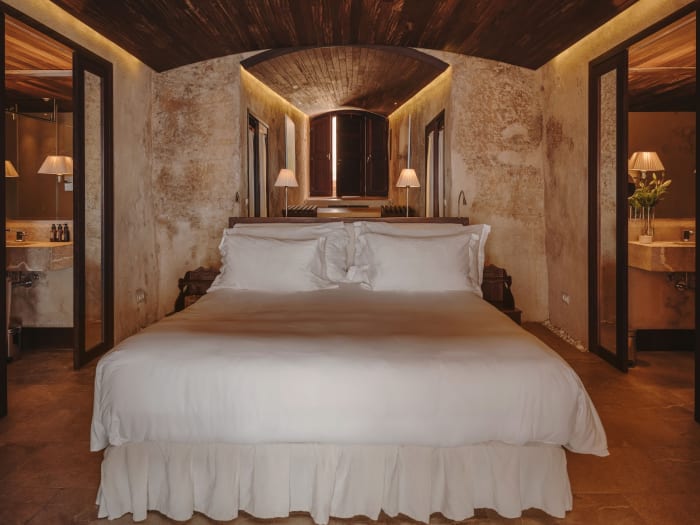
At Cap Rocat, rooms and suites continue the spirit of the place rather than pursuing display. Their interest lies not only in the comfort expected of a five-star hotel, but in the way private spaces extend the atmosphere of the fortress and the Mallorcan landscape. The same Mediterranean restraint appears here, through natural materials, calming tones and a very precise relationship with light. The result is neither austere nor overly decorative: it seeks balance between architectural character and a sense of refuge.
In a property housed within a historic structure, a standardised room would make little sense. One can therefore expect layouts that respond to the existing fabric, with volumes, perspectives and details varying according to position within the building. That diversity is part of the charm. It reminds guests that they are not sleeping in an interchangeable hotel, but in a place where each space has been shaped from what was already there. Thick walls, framed openings, transitions between indoors and outdoors, and the use of stone all contribute to that sense of singularity.
Comfort, meanwhile, is expressed through subtler gestures. Carefully prepared bedding, a calm atmosphere, attentive daily housekeeping and evening turndown service all help create a seamless experience without weighing it down. In a place this secluded, the room becomes more than a base; it is a genuine retreat, somewhere to read, rest and let time stretch. Views of the sea or surrounding landscape, where present, naturally matter, but the essentials often lie in the quality of the silence and the feeling of privacy.
The aesthetic seems guided by a simple idea: allowing the place to breathe. That means avoiding clutter, respecting the lines of the architecture and choosing elements that age well. At its best, this approach produces rooms that feel timeless rather than trend-led. It is especially apt in Mallorca, where beauty often lies in elemental things — warm stone, shade, saline air, the low light of late afternoon. A successful room in this context is one that welcomes those sensations rather than neutralising them.
For travellers seeking tranquillity, this coherence between architecture, decoration and service makes all the difference. Guests do not come here to collect design effects, but to inhabit a space conceived with restraint. Couples naturally find a setting conducive to privacy, while lovers of characterful places appreciate the way the hotel turns defensive heritage into a residential experience. At Cap Rocat, the room is not merely a functional chapter of the stay: it is one of its centres of gravity, a space in which one fully understands what it means to stay in a fortress opened to the Mediterranean.
The Dining Experience
At Cap Rocat, gastronomy aligns with the same aesthetic as the rest of the stay. It prioritises precision, setting, and rhythm.
In an establishment of this nature, one expects an experience that is coherent with the location. Meals extend the sensation of retreat. The ingredients engage in a dialogue with the island. The service is attentive yet unobtrusive, preserving the tranquillity of the guests.
Majorca offers a particularly rich culinary landscape. The island boasts a gastronomic tradition nurtured by the Mediterranean, featuring seafood, sun-kissed vegetables, olive oil, citrus fruits, and aromatic herbs.
At Cap Rocat, these raw materials find their meaning in a simple presentation. Breakfast is served with a view of the sea. Lunch is light, enjoyed in the warmth of the day. Dinner is more leisurely, as the stone retains its warmth.
Here, luxury is as much about the context as it is about the plate.
The setting plays a decisive role. Dining in a former fortress overlooking the Mediterranean alters the temporal experience of the meal. One lingers longer. The changing light is observed. Attention is paid to the wind, the marine scents, and the silence between tables.
This sensory dimension is essential in fine island addresses. It reminds us that gastronomy is not merely about a menu. It also depends on the environment, the quality of the welcome, and the atmosphere.
For travellers, the table at Cap Rocat can become a daily anchor. In the morning, it sets the tone for a day without haste. At noon, it accompanies the return from a swim, a terrace read, or an excursion. In the evening, it takes on a more theatrical dimension. The Mediterranean light and the architecture of the site create a memorable scene.
Couples find a fitting setting here, where intimacy does not need to be manufactured.
Dining is envisioned as a component to personalise. Depending on the rhythm of the stay, it may be relevant to favour certain timings, request a table with a view, or arrange a more private moment for a special occasion.
Cap Rocat lends itself to a destination dining experience. The table extends the landscape. Guests come to experience Majorca at its most tranquil, luminous, and sensual.
Spa & wellbeing
Wellbeing at Cap Rocat is not limited to the possible presence of a spa: it begins with the nature of the place itself. Silence, seclusion, the constant presence of the sea and the sheltering architecture of the former fortress already create the conditions for deep unwinding. In many hotels, the spa compensates for an environment that is too stimulating; here, it extends a state one feels from the moment of arrival. That distinction matters, because it says something about the philosophy of the stay: rest is not an activity added to the programme, but a rhythm that gradually settles in.
In Mallorca, this idea of wellbeing takes on a particular tone. The climate, especially in spring and autumn, encourages an outward-facing life of walks, sea bathing, time in the sun and then in the shade. In a protected natural setting such as Cap Rocat’s, these simple gestures recover an almost essential value. Rising early to enjoy the soft light, walking slowly through the grounds, pausing on a terrace, listening to wind against stone: all of these experiences belong to a discreet form of care, far removed from a standardised vision of wellness.
If one considers wellbeing in the hotel sense, a property of this level suggests an attentive, personalised approach fully integrated into the spirit of the place. That may involve body and facial treatments, massages adapted to the rhythm of travel, or moments of relaxation designed to rebalance after a journey or several days of exploration. In a place like Cap Rocat, the key is that such offerings should never disrupt the overall atmosphere. They should instead represent its fullest expression: a quiet luxury centred on recovery, presence and the feeling of being protected from the outside world.
Couples find an ideal setting here in which to slow down together. The environment lends itself to shared rituals, unhurried pauses and days that do not need every hour to be filled. For more active travellers, wellbeing may also take the form of balance between discovering the island and returning to calm. After time in Palma, a scenic drive or a stop at a cove, coming back to the mineral restraint of Cap Rocat feels almost therapeutic. The place absorbs agitation and restores the body to another tempo.
That is perhaps where its strength lies. Wellbeing is not presented as an abstract promise, but as the natural consequence of an exceptionally well-chosen site. The sea opens the horizon, stone brings coolness and stability, seclusion protects from noise, and discreet service allows guests to let go. For a restorative stay, a romantic celebration or a simple need to disconnect, Cap Rocat offers a mature version of wellness luxury: less demonstrative than genuinely regenerative, because it is grounded first and foremost in the place itself.
Concierge & Services
At Cap Rocat, the service remains discreet. Everything is taken care of without ever weighing down the stay.
The hotel offers a 24-hour concierge service, a 24-hour reception, daily room service, evening turndown service, luggage storage, laundry service, wake-up calls, and multilingual staff. Together, these services create a continuous, seamless, and personalised experience.
The concierge plays a central role. In an isolated hotel, it connects the sanctuary to the island. It allows guests to explore Mallorca without disrupting the balance of their stay. Whether it’s arranging a car at the desired time, recommending a beach or village, booking lunch outside, or providing logistical assistance upon arrival and departure, the service simplifies without standardising.
The continuously open reception offers genuine flexibility. It adapts to flight schedules, late arrivals, and last-minute requests. Daily room service and evening turndown further enhance this discreet comfort. Returning to a perfectly prepared room after a day in the sun or an excursion on the island lightens the stay.
The laundry service and luggage storage also facilitate Mediterranean stays. They allow for light travel, seamless transitions between multiple destinations, or full enjoyment of the last day. The multilingual staff ensures smooth communication, even for more specific requests.
Booking through MyConciergeHotel allows for a stay tailored to the traveller's profile. Whether it’s a romantic getaway, a restful interlude, or a measured exploration of Mallorca, certain preferences can be communicated in advance, whether it’s the desired pace, excursion wishes, or the pursuit of maximum intimacy. At Cap Rocat, the ideal service finely tunes the contours of the stay with precision.
The Mallorcan art of living
Staying at Cap Rocat also means choosing a certain idea of Mallorca. The island is often reduced to beaches and sunshine, yet it offers a more nuanced art of living, shaped by Mediterranean heritage, island culture, contrasting landscapes and a taste for slower rhythms. From this secluded hotel, one discovers a particularly balanced version of the destination: close enough to Palma for a cultural outing, yet far enough removed to preserve the feeling of retreat. That duality is part of its appeal. It allows guests to move from a contemplative day to a more active excursion without losing the thread of the stay.
Palma, accessible from the hotel, easily merits half a day or more. The Mallorcan capital combines a still-human scale, old streets, patios, pale stone façades and a constant relationship with the sea. It is a city to wander rather than rush through. The interest lies in details: a shaded square, a discreet courtyard, a well-chosen shop, a café in which to pause before returning to the calm of the coast. For travellers staying at Cap Rocat, Palma often works as a measured urban counterpoint, never overwhelming.
Beyond the city, Mallorca lends itself beautifully to contemplative itineraries. Hilltop villages, panoramic roads, pine-and-rock landscapes, coves with transparent water: the island rewards a fragmented exploration made of short stages and regular returns to the hotel. That is perhaps the best way to approach it from Cap Rocat. Rather than trying to see everything, one chooses a few well-composed sequences: a local market, a coastal walk, a simple lunch in a village, then a return to the fortress as the light begins to fade. The stay then gains coherence and depth.
The Mallorcan art of living also rests on a form of refined simplicity. It appears in materials, vernacular architecture, cuisine and the importance given to the gentlest hours of the day. This culture of outdoor living, of meals taken without haste, of the implicit pause when the heat rises, aligns perfectly with the spirit of Cap Rocat. The hotel does not impose a programme; it offers a framework from which each guest can compose a personal tempo. That is what makes it especially appealing both to travellers who already know the island and wish to rediscover a quieter version of it, and to first-time visitors approaching it from a more intimate angle.
The soundest advice may simply be not to overfill the stay. Mallorca reveals itself better when given room. A guided visit of the surrounding area, as suggested in the existing recommendation, can be an excellent way to understand the landscape, local history and the island’s contrasts. After that, very little is needed: an unhurried drive, a viewpoint, a swim, dinner back at the hotel. From Cap Rocat, the Mallorcan art of living appears in all its subtlety: elegance without emphasis, a direct relationship with sea and light, and the precious sense that time, at last, stops contracting.
Booking via MyConciergeHotel
Cap Rocat is best reserved with intention. More than just a five-star hotel in Majorca, it is a former fortress facing the Mediterranean, set in a preserved environment designed for calm and intimacy.
For couples, the focus may be on prioritising tranquillity. Arranging transfers from Palma airport, indicating a preference for relaxation, or planning a few discreet excursions can be key.
For a traveller already familiar with Majorca, it may involve refining the itinerary. The aim is to rediscover the island differently, through carefully chosen stops.
Spring and autumn are ideal for those seeking a gentler Majorca, with often more moderate crowds. Summer entices with outdoor living and proximity to the sea, but may require more precise planning.
Cap Rocat can also fit into a broader itinerary. Some travellers wish to combine a few nights of retreat with another Majorcan or Mediterranean stop, while others want to make the hotel their main destination.
In any case, it is important to respect the nature of the address. Cap Rocat should not be experienced as just a transient resort. It calls for a presence and a less hurried way of travelling.
Cap Rocat is particularly suited for couples, lovers of characterful places, and travellers seeking serenity. The address also appeals to those who appreciate architecture and landscape.
If you are looking for constant animation, the hotel is probably not the right choice. However, if you wish for a Mediterranean interlude where heritage, sea, and silence resonate, Cap Rocat deserves to be considered with care.