History & Heritage
In Dresden, certain addresses resonate more profoundly within the urban and cultural fabric of the city. The Hôtel Bülow Palais is one such establishment. Its identity is rooted in a form of continuity, characterised by a refined art of hospitality. In this destination, history, architecture, and music hold a unique significance. As a member of Relais & Châteaux, the hotel is part of a tradition of independent houses where character is as important as comfort.
The name of the establishment conjures the idea of an urban palace, without overwhelming monumentality. The tone is more subtle, embodying a European elegance that pays attention to proportions, materials, and the quality of service. In Dresden, a city marked by a significant baroque heritage, post-war reconstructions, and a vibrant cultural life, a hotel of this nature naturally finds its place. It engages in a dialogue with its surroundings, which lends it a muted tone, firmly rooted in the city.
The heritage of the Bülow Palais is also reflected in its ability to blend tradition and modernity. It offers an environment that neither succumbs to historicist reconstruction nor to the coldness of overly conceptual luxury. In such a house, elegance often arises from balance: a few classical references, volumes presented with discretion, well-integrated contemporary elements, and above all, a sense of harmony.
This notion of heritage extends beyond decor; it also pertains to the manner of hospitality. In a cultural destination like Dresden, some travellers seek more than just a place to stay. They look for an address that can accompany an opera visit, a discovery of museum collections, a weekend dedicated to architecture, or a few days of respite. The Bülow Palais meets this expectation with attentive hospitality, devoid of ostentation.
In Dresden, the experience of luxury is not merely defined by proximity to the most renowned monuments. It also depends on the quality of the neighbourhood, the serenity of the setting, and the ease of movement. The hotel, located in an elegant district, embraces its role as an urban refuge. It embodies the idea of a discreet grand hotel—a place that shields guests from the external pace while remaining connected to the city's life.
The Bülow Palais is less a transient stop than a destination for a stay. Its heritage is one of composed luxury and a tradition of hospitality that prioritises the permanence of standards, the quality of service, and a sense of appropriateness. This approach values moderation, culture, and sustainable comfort. In Dresden, it allows one to experience the city as a universe to be explored from a refined and stable base.
The Establishment
One of the most valuable qualities of an urban hotel lies in its ability to create a rhythm. The Bülow Palais embodies this philosophy. It offers a refined setting while allowing Dresden to take centre stage.
Situated in an elegant neighbourhood, the establishment benefits from an environment that enhances the overall experience. Luxury begins with the manner of arrival and continues with the ease of access to the city's cultural highlights.
This positioning is particularly suited to Dresden. The city attracts visitors with its collections, architecture, concerts, and riverside strolls along the Elbe. It maintains a rare balance between monumental heritage and an easily navigable scale.
Staying in a distinguished area allows for a more nuanced approach to the destination. One is neither isolated nor overwhelmed by the hustle and bustle. This urban breathing space is ideal for both short stays and extended visits.
The Bülow Palais caters to travellers who appreciate characterful hotels. They will also find a genuine fluidity of use here. Easy access to cultural attractions is of great importance.
In a city like Dresden, the quality of the anchor point makes all the difference. Returning to a calm and well-maintained place lends a particular coherence to the stay.
The overall atmosphere of the establishment is warm and refined. This combination remains quite rare. Here, the common areas seem designed to welcome as well as to structure the experience.
The design, which blends tradition and modernity, aligns with this intent. It offers a contemporary interpretation of luxury without breaking away from the spirit of a grand European address.
For couples, the hotel is well-suited for a cultural stay punctuated by moments of retreat. For business travellers, it provides a discreet and well-organised base. For art city enthusiasts, it complements Dresden without overshadowing it.
Spring and summer are particularly suitable for this address. The city becomes more vibrant during these seasons. Walking around becomes more natural, and strolls take on a new dimension.
Even in the off-season, the hotel retains its appeal. One can enjoy a more intimate atmosphere, characterised by comfort, calm, and interludes between cultural engagements.
Thus, the Bülow Palais embodies a certain vision of a grand city hotel. A human-scale address, carefully curated without rigidity, rooted in a beautiful neighbourhood. In Dresden, this formula makes perfect sense.
Rooms and Suites
At the Bülow Palais, the room serves as the gravitational centre of the stay. After visiting museums, taking strolls, or enjoying cultural evenings, it is here that the quality of a hotel is truly measured.
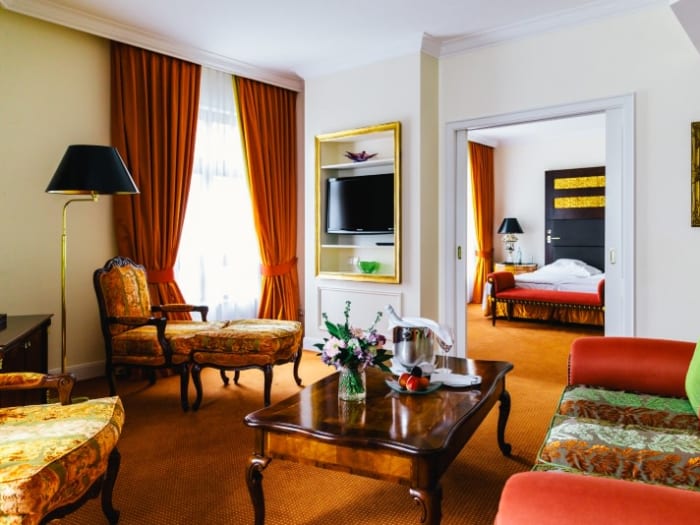
The spirit of the rooms and suites is reflected in a warm atmosphere, a design that blends tradition and modernity, and a luxury focused on intimacy.
Expect spaces designed for rest, with attention to tones, materials, and visual balance. Comfort is not solely about surface area or amenities; it also depends on how the room welcomes the gaze and the body.
A beautiful city room should allow one to slow down. It must provide a sense of refuge without falling into impersonal neutrality. A design that articulates heritage with contemporary touches can make all the difference.
The notion of intimacy remains essential. In Dresden, stays are often punctuated by outings, visits, and movements. Returning to a calm, orderly, and soothing room becomes a decisive part of the experience.
Couples will seek a setting conducive to relaxation, reading, or conversation after dinner. Business travellers will appreciate a seamless transition between work, recuperation, and sleep.
Service plays a central role here. Amenities include daily room service and turn-down service. These thoughtful touches give the room a particular sense of time. It is rediscovered, tidied up, and prepared for the evening or the next stage of the stay.
In a house that is a member of Relais & Châteaux, one also expects coherence between private spaces and the overall identity of the establishment. The rooms and suites naturally extend the hotel's atmosphere. This is achieved through measured furnishings, meticulous finishes, quality bedding, bathrooms designed for everyday comfort, and a well-mastered overall impression.
For stays of several nights, the quality of a room also reveals itself in its ability to become a temporary living space. One can leave books, purchases, concert programmes, or visit notes there. It is a place to enjoy a coffee, a moment of silence, or a preparation before dinner.
At the Bülow Palais, the room thus contributes to the overall allure of the journey. It protects, rests, and extends the elegance of Dresden, within a setting true to the spirit of the house.
Dining
The gastronomy of a hotel in this category is not judged solely by the sophistication of the plate. It is also measured by its ability to express a place, to shape the rhythm of a stay and to offer the traveller a sensory reading of the destination. At Bülow Palais, the cuisine is described as showcasing local produce. This indication, understated yet essential, is enough to suggest a clear direction: a table attentive to its region, to seasonality and to a form of authenticity that excludes neither refinement nor invention.
In a city such as Dresden, this approach makes particular sense. The cultural experience is dense, and the meal often becomes a moment of recentring. After a day spent among heritage sites, collections and urban walks, one expects a hotel restaurant to offer more than convenience. One looks for atmosphere, precision of service and a certain relationship to time. The concierge’s advice to reserve a table in advance suggests that the restaurant genuinely matters within the experience of the house. That is generally the sign of an address where dining is not incidental, but fully integrated into the hotel’s identity.
Highlighting local produce implies several things. First, attention to freshness and provenance, which anchors the meal in a real geography rather than in abstract luxury. Second, a desire to place the hotel’s cuisine in dialogue with regional resources, whether seasonal vegetables, meats, freshwater fish, cheeses or preparations inspired by the local repertoire. Finally, it suggests a certain stylistic restraint: when the product is central, presentation benefits from remaining legible. In good houses, that clarity is often the true sign of culinary maturity.
The setting matters just as much. In a property whose design blends tradition and modernity, the dining room likely extends that same happy tension between heritage and the contemporary. One may imagine a carefully considered décor, free of stiffness, suited equally to dinner for two, a business meal or a more ceremonial evening. Service, in a five-star Relais & Châteaux hotel, is expected to operate in a register of discreet precision: smooth welcome, knowledge of the menu, proper pacing between courses and the ability to accompany without intruding.
Breakfast, too, deserves to be considered as a moment in its own right. In fine city hotels, it often sets the tone for the day. A good breakfast is not merely abundant; it should be calm, well organised and varied enough to suit both travellers in a hurry and those wishing to linger before heading out to explore the city. In a house attentive to local produce, this first meal may also offer a more immediate reading of the region through breads, preserves, dairy products or seasonal specialities.
For guests who choose to dine in-house, the principal appeal often lies in this continuity of experience: one leaves the room, returns to the dining room, settles into a controlled atmosphere, then retires again without interruption. That fluidity is one of the great privileges of a fine city address. It allows a stay to be composed in which gastronomy is neither a social obligation nor a mere service, but a coherent chapter of the journey.
At Bülow Palais, dining therefore appears to contribute fully to the hotel’s overall elegance. Without making noisy promises, it asserts a sound direction: to value local produce, to situate the meal within a refined setting, and to offer travellers a culinary experience in keeping with the spirit of Dresden. That is often how the best hotel tables endure in memory: not through excess, but through precision, consistency and an intelligent sense of place.
Wellness & Moments of Calm
Within the Bülow Palais, the Palais SPA offers a discreet retreat designed to slow down the pace without compromising the elegance of the surroundings.
Spanning 400 square metres, the space exudes a subdued atmosphere, ideal for relaxation after a day exploring Dresden. The entire area maintains an intimate scale.
Four treatment rooms shape the experience, focusing on comfort and precision in every touch. The wellness journey is complemented by a hammam and a sauna.
The treatment menu prioritises clear, accessible therapies aimed at muscle relaxation and recovery. Body massages, both partial and full, naturally feature prominently.
Targeted back massages help to release built-up tension. Legs and feet also benefit from dedicated treatments, particularly welcome after long hours of walking.
To extend this sensation of tranquillity, the Palais SPA also offers body scrubs and wraps. This gentle approach allows for a return to a slower rhythm of breathing.
Here, wellness does not seek to impress with spectacle. Instead, it embodies a more authentic notion of calm, with essential facilities and thoughtfully selected treatments.
Concierge & Services
At Bülow Palais, the service is characterised by a finely tuned discretion. Arrival is seamless, thanks to the valet service, which is particularly appreciated in this area of Dresden.
For transportation, a paid airport transfer can be arranged. This is a straightforward solution for managing a late arrival, an early departure, or a stay conducted at a precise pace.
Communication with the team remains fluid for an international clientele. English, Spanish, French, Dutch, Polish, and Portuguese are spoken on-site, facilitating both practical requests and last-minute adjustments.
Guests travelling with pets also receive dedicated attention. Pet amenities are provided, reflecting a thoughtful approach to shared comfort without complicating the stay.
Overall, the concierge service strikes a measured tone, attentive to useful details. Here, service does not seek to be ostentatious. It supports, anticipates, and simplifies, embodying the restraint that befits distinguished urban addresses.
The Dresden Way of Life
Staying at Bülow Palais also means choosing a particular way of entering Dresden. Not all art cities are discovered in the same manner. Some impose a tightly packed programme; others lend themselves to a more nuanced exploration, made of movements between monuments, neighbourhoods, culinary pauses and moments of contemplation. Dresden belongs to the latter category. Its history, its patiently reconstructed heritage, its relationship with music and the arts, and its setting on the Elbe all combine to form a city that is savoured as much as visited. A hotel located in an elegant district and offering easy access to cultural attractions becomes, in this context, a true lens through which to read the destination.
Dresden’s appeal lies in this coexistence of grandeur and legibility. It offers major architectural ensembles, leading cultural institutions and a dense European memory, yet without the overwhelming scale of certain capitals. Travellers can shape their days with flexibility: devote a morning to collections, continue with a walk, linger in a café, return to the hotel to rest, then head out again for dinner or an evening performance. Bülow Palais seems particularly well suited to this kind of stay, in which the chosen address supports the city’s rhythm rather than disrupting it.
For lovers of architecture, Dresden offers a fascinating field of observation. The dialogue between Baroque heritage, reconstruction and more contemporary interventions gives the city a singular depth. For music lovers, the destination immediately evokes a tradition of the highest order. For travellers drawn to decorative arts, painting or historical collections, it is also a major stop in Central Europe. In every case, the experience gains from being lived from a hotel that shares this taste for composition, restraint and continuity. That is precisely what the positioning of Bülow Palais suggests.
The neighbourhood matters as well. A fine district changes the way one inhabits a city, even for a few days. It influences one’s relationship to time, the quality of walking, the pleasure of returning at day’s end. In an elegant environment, one perceives more clearly the transitions between the intensity of visits and the calm of return. This is especially appreciable in spring and summer, noted as the most pleasant seasons for visiting Dresden. The light, the city’s livelier atmosphere and the possibility of extending the day outdoors all enhance the appeal of a well-located stay.
Yet the Dresden way of life is not reduced to a sequence of emblematic sites. It also lies in simple gestures: taking time over breakfast before heading out, choosing not to see everything, leaving room for the unexpected, returning in the afternoon to pause, dining without haste. The best stays are often those that preserve this balance between programme and openness. A hotel such as Bülow Palais, through its welcoming atmosphere and quality of service, appears to provide precisely that flexible framework.
For French, British and international travellers, Dresden may represent a particularly appealing alternative to Europe’s more predictable destinations. It offers the cultural density of a major historic city, but with a different breathing space, a calmer relationship to scale and a less demonstrative elegance. This corresponds well to the spirit of a Relais & Châteaux house: privileging the right experience, the sensory quality of the stay, and the feeling of having chosen an address that illuminates the destination rather than reducing it to a checklist.
In that sense, Bülow Palais is not merely a place to sleep in Dresden. It is a way of inhabiting the city with precision, comfort and discernment. It allows one to grasp its nuances, respect its rhythm and appreciate its culture without haste. Perhaps that is, in the end, the finest definition of urban luxury: to have a place that makes one want to discover more, while offering each evening the simple pleasure of returning to a house equal to the day just lived.
Book with MyConciergeHotel
Choosing Bülow Palais through MyConciergeHotel means favouring an approach to travel that gives as much importance to the address as to the way it is organised. A five-star Relais & Châteaux hotel, set in one of Dresden’s elegant districts and suited both to cultural stays and more professional trips, deserves preparation equal to its positioning. The value of an editorial concierge service lies not only in the booking itself, but in its ability to guide the choice, place the experience in context and help the traveller draw the very best from the stay.
Bülow Palais speaks to several kinds of traveller, which is precisely why such guidance is useful. A couple may be seeking a refined escape with an easy rhythm, good dinners and simple access to major cultural sites. An art lover may chiefly want to optimise visiting days while keeping a calm and elegant base. A business traveller will prioritise reliability of service, discretion of welcome and logistical smoothness. In each case, booking with discernment means understanding the spirit of the house and how well it suits the intended stay.
MyConciergeHotel makes it possible to approach this booking with a more qualitative reading than a purely transactional one. It is not simply a matter of comparing rates or categories, but of understanding why this address suits Dresden, what kind of journey it best serves, and how it fits into a wider itinerary. A hotel such as Bülow Palais makes full sense when considered as a refined cultural base, a well-located urban retreat and a house whose service genuinely supports the experience. That prior understanding changes both the act of booking and the way the stay is ultimately lived.
One practical point worth anticipating concerns the hotel restaurant. The existing advice to reserve a table in advance is particularly relevant. In fine houses where dining forms part of the identity, leaving things until the last moment may limit options, especially during the most pleasant seasons or over a cultural weekend. A well-prepared booking therefore helps secure that continuity between accommodation and gastronomic experience which matters greatly in the success of a city stay.
Booking through MyConciergeHotel also means benefiting from an editorial perspective capable of placing the hotel within its environment. In Dresden, that means understanding the value of staying in an elegant district rather than focusing solely on immediate monument proximity, recognising the importance of easy access to cultural attractions, and appreciating the worth of a warm atmosphere when one is planning full days. These are nuances not always visible in standardised descriptions, yet they profoundly shape final satisfaction.
For discerning travellers, the ideal booking is one that reduces uncertainty. It clarifies the style of the property, its level of service, its suitability to the season, the kind of experience it encourages and the points worth anticipating. Bülow Palais, with its design blending tradition and modernity, its dining focused on local produce and its round-the-clock concierge and reception services, offers a coherent proposition for discovering Dresden with elegance. It simply needs to be booked for the right reasons, and at the right moment.
That is precisely the promise of MyConciergeHotel: to turn a simple reservation into an informed choice. In the case of Bülow Palais, that means recognising the value of a house with character, understanding what it offers beyond standard accommodation, and preparing a stay in which every element — neighbourhood, rhythm, dining, service and access to culture — contributes to a harmonious whole. In Dresden, that intelligence of travel makes all the difference.