History & Spirit of the Place
Ahãma embodies a vision of travel where the destination is as significant as the landscape. Located in Muğla, in the southwest of Turkey, the hotel is set within a preserved natural environment. Guests are drawn here not for a bustling social scene, but for a tranquil relationship with time, light, and the sea.
Affiliation with Relais & Châteaux illuminates this philosophy. The brand signifies a commitment to hospitality, attention to detail, and local roots. At Ahãma, this promise manifests in an atmosphere that prioritises authenticity over ostentation. The personalised service contributes to this impression, with experiences tailored to the pace of the guests, catering to those seeking a more leisurely stay.
The spirit of the place is founded on a balance between contemporary comfort and authenticity. Along the Turkish Aegean and Mediterranean coasts, Ahãma advocates for a sense of restraint. Here, luxury is expressed through preserved silence, a respectful integration with the surroundings, and an intimate ambiance. This explains its appeal for romantic getaways. The natural decor and peaceful atmosphere create an ideal setting for couples to enjoy their time together.
More than just a hotel, Ahãma can be seen as a contemporary refuge. Travellers find a place where they can inhabit a landscape while enjoying five-star service. This relationship between the home and its territory lends coherence to the stay, making the location equally relevant in spring and autumn when the light is crisp and temperatures are pleasant.
Ahãma champions a culture of high-end hospitality that seeks to preserve what is essential. The establishment resonates with those who value a grand stay defined by atmosphere, service precision, and how a hotel reveals its environment. It is this coherence that forms its identity.
The Establishment
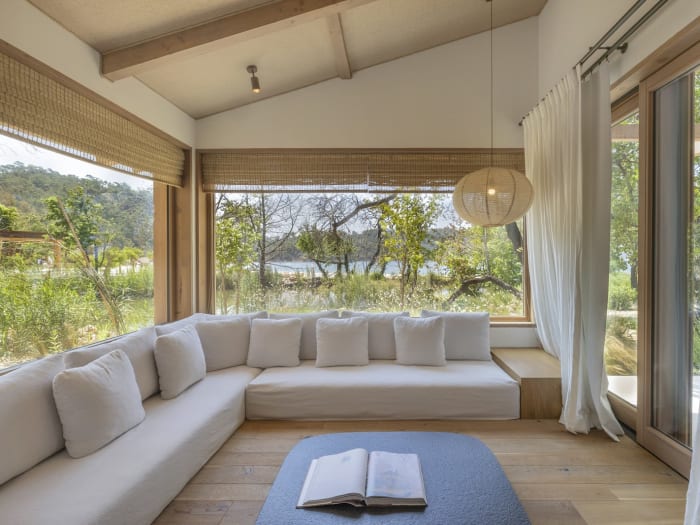
The foremost luxury of Ahãma lies in its location. In a region where nature remains one of the great privileges of travel, the hotel is nestled within a preserved environment. The gaze is drawn to Mediterranean vegetation, gentle hills, and shifting light. The design of the property seems intended to allow the landscape to breathe. The stay begins with a sense of space, calm, and coherence.
The establishment cultivates a peaceful atmosphere. In resort hospitality, calmness is as much an architectural quality as it is a service one. It requires mastery of circulation, discreet organisation of teams, and well-orchestrated practices. At Ahãma, the communal spaces extend the serenity of the site. Terraces open to the landscape, airy lounges, and transitional areas create a fluid ensemble. Here, luxury does not seek to impress; it places the traveller in a favourable state of mind.
This restraint is reflected in the overall perception of the establishment. A five-star hotel of this calibre does not need to accumulate effects to assert its status. What matters is the quality of materials, attention to proportions, and the fluidity between indoor and outdoor spaces. Ahãma belongs to that category of establishments where elegance arises from a controlled simplicity. The natural setting is not an added decoration to the experience; it is the centre of gravity. Guests stay here to rediscover a form of clarity without sacrificing the comfort expected from a high-end establishment.
The positioning of the hotel makes it particularly suitable for couples. This is due to the overall intimacy of the place and the opportunity to create leisurely days together without constraints. A slow morning, lunch on the terrace, a swim, a treatment, an evening stroll, followed by a prolonged dinner. The establishment offers this rhythm sought by travellers who wish to reconnect. This quality of experience is essential, making Ahãma not only a beautiful hotel but also a habitable retreat.
The establishment also meets contemporary expectations. It embodies a luxury that is more attuned to context and less ostentatious. The identity of Ahãma rests on a blend of nature, comfort, and personalised service. This is a demanding equation, requiring a high level of service while maintaining a sense of simplicity. When successful, it creates that rare feeling of an effortless stay, where everything seems perfectly in place.
In summary, Ahãma stands out for its atmospheric quality rather than a catalogue effect. The place invites guests to slow down, observe, and enjoy a less domesticated environment. For travellers familiar with grand seaside addresses, the difference often lies in the ability of a hotel to offer a way of inhabiting the landscape with authenticity.
Rooms and Suites
At Ahãma, the room extends the hotel's relationship with its surroundings. It embodies a philosophy of calm, intimacy, and comfort.
In a five-star establishment set within a preserved natural environment, the rooms and suites primarily offer silence, fluidity, and effortless comfort.
Refinement here lies in the mastery of space and materials. A holiday room does not need to be ostentatious; it should simply be just right.
This entails clear lines, tactile materials, impeccable bedding, and bathrooms designed for long stays. The flow between the various uses of the space should remain natural.
One can read, rest after a day at the beach or a stroll, and prepare for dinner in these rooms. Sometimes, one enjoys a coffee early in the morning. The best rooms enhance these moments without imposing on them.
At Ahãma, this quality of use seems essential. The accommodation contributes to a sense of intimacy, with spaces opening onto the landscape, private or semi-private exteriors, soothing tones, and sustainable decor defining its spirit.
The aim is not to distract from the site but to frame it. A well-placed window, a terrace shielded from prying eyes, a comfortable seating area, a bright bathroom—these elements often determine the success of a room.
Personalised service also plays a crucial role. Comfort hinges on how well preferences are understood and anticipated. Timings, cleaning rhythms, thoughtful gestures, assistance with daily organisation—all these lighten the stay.
For couples seeking tranquillity, this discretion is invaluable. It preserves the sensation of having one's own space, combined with the efficiency of a grand home.
The rooms and suites at Ahãma are experienced as places of respite. In a region abundant in light and landscapes, they provide the necessary counterpoint: freshness, rest, intimacy.
While the common areas open up to nature, the rooms allow for a more personal engagement with it. They welcome the slow hours of morning as well as the return of evening.
For the discerning traveller, this dimension is crucial. An excellent room is marked by what it makes possible: better sleep, better recovery, and a deeper enjoyment of the place.
At Ahãma, the accommodation embodies a balance between luxury and nature. It is not an autonomous decor but a sensitive, precise, and enduringly pleasant setting.
Dining
In a hotel where the natural environment plays a central role, the gastronomy extends the sense of place. At Ahãma, it is integrated into the setting. The cuisine is clear, refined, fresh, and attuned to the seasons and the natural rhythm of the day.
In a Relais & Châteaux establishment of this nature, the culinary experience is grounded in precision, controlled simplicity, and a sense of hospitality that goes beyond the plate.
Breakfast often stands out as one of the highlights of the stay. It sets the tone. At Ahãma, it favours the calm of the early hours, soft light, and carefully prepared products. In a Mediterranean setting, the morning meal takes on an almost ceremonial dimension. Fruits, breads, savoury and sweet preparations, hot beverages, and sometimes a few local specialities. The essence lies in the quality of execution and the attention given to each individual’s rhythm.
The rest of the day calls for a cuisine that engages in dialogue with the climate and landscape. In the Muğla region, travellers seek meals that accommodate the sea, swimming, strolling, and resting. A good holiday table responds with light lunches, well-thought-out snacks, and more leisurely dinners.
The atmosphere is as important as the menu. A well-oriented terrace, discreet service, the light of the late day, and an understated presentation all contribute significantly to the experience.
In the Relais & Châteaux universe, dining is also a vector of territory. At Ahãma, it expresses a Turkish and Mediterranean anchoring through the products, certain preparations, seasonings, and meal compositions. This approach resonates with an international clientele that is discerning and attentive to what the cuisine reveals about the place. Authenticity here does not stem from folklore; it is conveyed through a contemporary, elegant interpretation that remains true to the spirit of the house.
For couples, the culinary dimension takes on added value. A peaceful hotel is also judged by the quality of its dining experiences. Enjoying a quiet lunch, having a drink in a relaxed atmosphere, dining leisurely without the sensation of being rushed. Personalised service finds a natural outlet here. Recommendations, adjustments, and attention to preferences transform the meal into a complete hospitality experience.
Thus, the dining experience at Ahãma is envisaged as an essential component of the stay, on par with the room or the landscape. It does not need to position itself as an autonomous gastronomic destination. It coherently accompanies the whole. This is often the best path in such a high-end refuge—a cuisine that soothes, connects, and reveals, without breaking the thread of serenity.
Wellness & Reconnection
At Ahãma, wellness transcends the confines of a spa. It primarily relates to an overall quality: silence, nature, light, and a sense of time regained.
The peaceful atmosphere and the hotel's ability to host tranquil retreats place this dimension at the heart of the stay. The traveller seeks not just services but a state of being. Here, rest begins with the place itself.
In contemporary luxury hospitality, the most genuine wellness often avoids excess. It creates the conditions for true decompression. A preserved natural environment contributes fully to this.
Walking in peace, breathing in the sea or forest air, swimming, reading in the shade, rediscovering deep nights—these simple gestures often form the best routines. Ahãma offers this, with the comfort and attention of five-star service.
Personalised service takes on a particular significance here. A great hotel knows how to tailor its recommendations to each individual's energy level, desires, and pace. Some will structure their stay around treatments, while others may prefer swimming, resting, and a few carefully chosen attentions.
For couples, this reconnection is highly valued. It may take the form of a morning without a schedule, a moment of silence facing the landscape, or a dinner after a day spent outdoors. In a peaceful hotel, these sequences flow naturally. Luxury then lies in a regained availability.
The Muğla region particularly lends itself to this interpretation of travel. Between sea, nature, and Mediterranean light, it fosters a wellness anchored in the outdoors. Spring and autumn further enhance this quality, with milder temperatures and a more relaxed pace.
At Ahãma, wellness is understood as a holistic experience of rebalancing. Whether through the outdoors or the quality of silence, it arises from a single intention: to allow the traveller to refocus. Here, serenity constitutes the very essence of the stay.
Concierge & Services
Personalised service is one of the elements explicitly associated with Ahãma, and it is arguably among the most decisive criteria for understanding the true level of a property. In luxury hospitality, service is not simply a matter of availability; it is a matter of accurate reading. Knowing when to step in, when to withdraw, how to suggest without imposing and how to simplify without standardising—this is what distinguishes a team genuinely trained in high-end hospitality. In a hotel defined by a peaceful atmosphere, that relational intelligence matters even more, because it must support the overall calm rather than disturb it.
At Ahãma, one can reasonably expect a concierge approach capable of shaping tailored stays, especially for couples or travellers seeking a quiet retreat. That may involve organising transfers, arranging outdoor activities, suggesting the best times to enjoy the surroundings or preparing more intimate moments within the property itself. The point is not the multiplication of options, but the relevance of advice. A good concierge knows how to read a stay: some guests will want to explore, others to remain almost entirely on site, and many will alternate between the two. The team’s role is to make that rhythm feel effortless.
In a region such as Muğla, where natural and coastal attractions are numerous, the quality of guidance makes a real difference. Experienced travellers do not simply want generic information; they appreciate recommendations calibrated to the season, the weather, the time of day and their own pace. Spring and autumn, identified as particularly pleasant periods, call for different suggestions from those of the height of summer. An attentive house will steer guests towards experiences that respect both their desire to discover and their need for quiet.
Personalised service is also measured in daily details. Flexibility, attention to preferences, the ability to solve an issue discreetly and the quality of communication before and during the stay all contribute to the feeling of being well looked after. In the best hotels, this efficiency remains almost invisible. Things simply happen, without friction and without performance. It is precisely that smoothness which creates trust and allows the traveller to relax fully.
For couples, this quality of service is especially valuable. It makes it possible to shape a stay that feels less like a fixed programme and more like a sequence of well-judged moments. A dinner booked at the right time, an outdoor activity arranged without complication, a thoughtful gesture to mark an occasion, a pace respected without over-follow-up: these are the details that turn a good hotel into one guests recommend. In a Relais & Châteaux property, that dimension is naturally expected, as it forms part of the label’s implicit promise.
Ultimately, Ahãma’s concierge and services should be understood as an art of discreet accompaniment. They do not seek centre stage; they aim to make the stay simpler, smoother and more personal. It is a particularly contemporary form of luxury, and perhaps the most lasting one: the feeling of being understood without having to ask for everything. In an unspoilt natural setting, where guests come precisely to slow down, that quality of service takes on even greater value. It allows the property fully to deliver on its promise of refuge.
The Muğla Way of Life
Staying at Ahãma also means entering into a particular relationship with Muğla and, more broadly, south-western Turkey. The region is not merely a seaside destination; it is a combination of landscapes, rhythms and holiday traditions that make it one of the country’s most appealing territories. Between the Aegean and the Mediterranean depending on the area, Muğla suggests indented coastlines, clear water, pine-covered hills, villages, harbours and panoramic roads where light plays a constant role. For the traveller, this diversity creates a sense of abundance without overload: there is always something to see, yet nothing compels one to do everything.
That is precisely what makes the region so well suited to Ahãma’s spirit. A hotel set in an unspoilt natural environment allows guests to experience Muğla not as a checklist of excursions, but as a territory to inhabit. One may choose to set out early and explore in the cool of the morning, devote the afternoon to rest, then go out again in the golden hour. Or one may decide to remain largely on site and let the landscape come to oneself. This flexibility lies at the heart of the local way of life as sought by seasoned travellers: enjoying without over-scheduling, observing without consuming the place too quickly.
Spring and autumn, recommended in the existing description, are particularly revealing of this quality. The region becomes more legible then. Milder temperatures, often beautiful light and generally lighter footfall make it easier to appreciate the contours, shorelines and villages in greater calm. For couples, these are ideal seasons: they restore a sense of availability that favours long walks, lingering lunches, swims when the weather allows and the feeling of discovering a more breathable version of the eastern Mediterranean.
The Muğla way of life also rests on an outdoor culture. Days naturally organise themselves around the sea, the terrace, shade, walking and meals taken at an unforced pace. One understands why the existing concierge tip recommends prioritising outdoor activities. In a region so generous in scenery, going outside is not necessarily a sporting obligation; it is a way of entering into relation with the place. A simple walk, a moment by the water or a drive taken at the right time of day may be enough to define the tone of the stay.
For a hotel such as Ahãma, this territorial dimension is essential. Luxury here does not consist in completely isolating the traveller from the outside world, but in offering a high-quality anchor point from which to discover the region at one’s own pace. That is an important distinction. The best resort addresses do not seek to replace their destination; they interpret it, soften it and make it more accessible. Ahãma appears to belong to that category.
To stay here, then, is to adopt, if only for a few days, a more accurate rhythm. Muğla emerges as a territory of breathing space, light and sophisticated simplicity. One learns to value quiet hours, unforced landscapes, meals taken without haste and the return to the hotel after time spent outdoors. That, perhaps, is the true local art of living: allowing the beauty of the setting to organise the stay without ever overwhelming it.
Book with MyConciergeHotel
Booking Ahãma through MyConciergeHotel means approaching the property in the way that suits it best: with a stay prepared precisely, without rigidity, and shaped around the way you actually travel. A hotel such as this is not chosen solely for a room category or a date. It is chosen for an atmosphere, for a certain relationship with calm, for the quality of personalised service and for the promise of an unspoilt natural setting. The value of editorial and concierge support lies precisely in turning those elements into a coherent stay, based on your real priorities.
For a couple, for instance, the right booking is not simply the one that secures availability. It is the one that aligns the travel period, the desired rhythm and the most suitable experiences. Spring and autumn, already identified as particularly pleasant, can offer a softer, more breathable reading of Muğla. Depending on your wishes, it may be wise to favour a stay centred on rest, or instead a balance between time at the hotel and time spent exploring. In both cases, advance preparation makes a tangible difference. It avoids default choices and allows you to enter the stay with a genuine sense of ease.
MyConciergeHotel can help define that experience before arrival. That means asking the right questions: are you primarily seeking a retreat for two, a digital detox, a few days in nature with a high level of comfort, or a stop within a broader Turkish itinerary? Would you like to arrange outdoor activities, reserve particular moments, or simply ensure that everything will feel smooth once on site? In a hotel where personalised service is a core component, this preparatory phase is far from incidental. It often shapes the perceived quality of the entire stay.
Booking through us also means benefiting from an editorial point of view. We do not aim to over-promise; we aim to match the property to the right expectation. Ahãma will particularly suit travellers who are sensitive to the balance between luxury and nature, those who prefer intimacy to animation and those who believe that a great hotel should first offer quality of atmosphere. If that is what you are looking for, the address has every reason to resonate. If your expectations differ, it is better to know that before confirming. That honesty is part of how we work.
Finally, booking early remains a sensible recommendation for this kind of property, especially when it appeals to a demanding clientele and is particularly well suited to couples. The most desirable periods and configurations often require anticipation. By entrusting us with your plans, you gain not only time, but also a more nuanced understanding of what truly makes the stay successful: the right tempo, the right context and the right choices.
Ahãma is not an address to consume quickly. It is a place to inhabit for a few days, in the right season and with the right frame of reference. MyConciergeHotel helps you build that sense of rightness. Our role is not only to book; it is to ensure that the experience begins before departure, in the clarity of decisions and the quality of preparation.