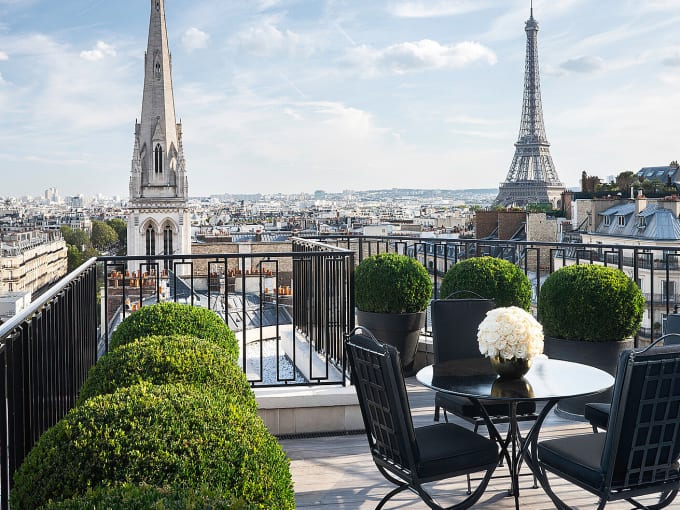
In Paris, few areas encapsulate as many hotel symbols as the triangle formed by Avenue George V, Avenue Montaigne, and the surroundings of the Champs-Élysées. Here, the palace is not merely an official category; it represents a way of experiencing the city. Guests find themselves just minutes away from renowned fashion houses, jewellery headquarters, discreet galleries, and power addresses. The district attracts an international clientele, as well as French travellers seeking a central, accessible Paris. In this area, the stay is defined as much by the location as by the rhythm of life. One strolls out on foot, returns late, entertains, works, and then allows for genuine recovery time. It is precisely this density of experiences that makes the subject intriguing.
To establish this editorial ranking, we first consider the facts. The Atout France Palace status serves as a crucial reference point. We then examine the actual location within the Champs-Élysées ecosystem, the coherence of the experience, the perceived quality of service, the international reputation of the establishment, and its ability to cater to diverse stays. A palace in this sector may entice with its suites, spa, discretion, gastronomic scene, or immediate proximity to Avenue Montaigne. At MyConciergeHotel, we also take into account practical usage. A hotel may be exceptional for a fashion weekend, while another may be more suitable for a long stay, business trip, or first-time exploration of Paris. It is important to note that the ranking does not reward mere image; it prioritises the alignment between promise, location, and execution.
The landscape of palaces around the Champs-Élysées is more varied than it appears. Four Seasons Georges V embodies a form of grand Parisian classicism, expertly realised, in a location that has become a global landmark. Plaza Athénée Paris plays a central role on Avenue Montaigne, with a direct connection to fashion and urban staging. Hôtel de Crillon, located at Place de la Concorde, opens the area to a more monumental interpretation of Paris. The Royal Monceau Raffles Paris offers a more contemporary, art-forward interpretation, at the edge of the Étoile. La Réserve Paris – Hotel and Spa favours a more intimate scale, highly sought after by those desiring privacy without straying far from the centre. Finally, Bulgari Hotel Paris presents a more recent vision of the Parisian palace, with a clear aesthetic language and a strong wellness culture. This proximity explains why the sector remains so closely observed.
The trends for 2025-2026 confirm several underlying movements. Firstly, the palace on the Champs-Élysées is no longer merely a prestigious backdrop; it must serve as a comprehensive accommodation tool. Travellers expect a room designed for recovery, work, and entertaining. The spa has become a decisive criterion, not as an add-on, but as a central component. Family suites, connecting rooms, and privacy measures are also gaining importance. We are also observing a more nuanced demand for local anchoring. Clients want to be at the heart of Paris, but without excessive noise or disruptive traffic. Finally, visible luxury is giving way to readable luxury. Materials, acoustics, the fluidity of arrivals, sleep quality, and service precision matter more than mere spectacle. My advice in this neighbourhood is to choose a location based on your actual pace, rather than its sole renown.
Discussing the palaces of the Champs-Élysées also involves a certain idea of French luxury. It is neither limited to ostentation nor to rigid tradition. It rests on balances. Architecture converses with service. Ceremony remains present, but it must remain fluid. Refinement is evident in the upkeep of the establishment, the quality of communal spaces, and the manner of welcoming without overplaying distance. In this district, this philosophy takes various forms. It can be very classic, very couture, very residential, or more contemporary. What our advisors often observe is that the best stays arise from a correspondence of style. Some travellers seek an immediately recognisable Parisian palace, while others prefer a more subdued, almost private address. Both approaches have their legitimacy, as long as the promise is consistently upheld.
Thus, this ranking should be read without a reflex of superlatives. A number one does not negate the qualities of the following. Each palace in this sector meets a particular expectation, sometimes very specific. One may be ideal for experiencing Paris through shopping, meetings, and dinners, while another may be better suited for a recovery retreat, with a strong emphasis on the spa and discretion. A third will appeal to heritage enthusiasts, those seeking views, or fans of grand international hospitality. At MyConciergeHotel, we prefer reasoned hierarchies over definitive verdicts. The right question is not merely which is the best palace, but which palace on the Champs-Élysées will suit you best, now, for this specific trip. This is also why our perspective remains editorial. It aims to guide, not to homogenise experiences that, by nature, remain unique.
In the following Top 6, you will find six ways to experience Paris in the 8th arrondissement. Some are iconic, while others are more discreet. All contribute to the contemporary definition of a palace around the Champs-Élysées.