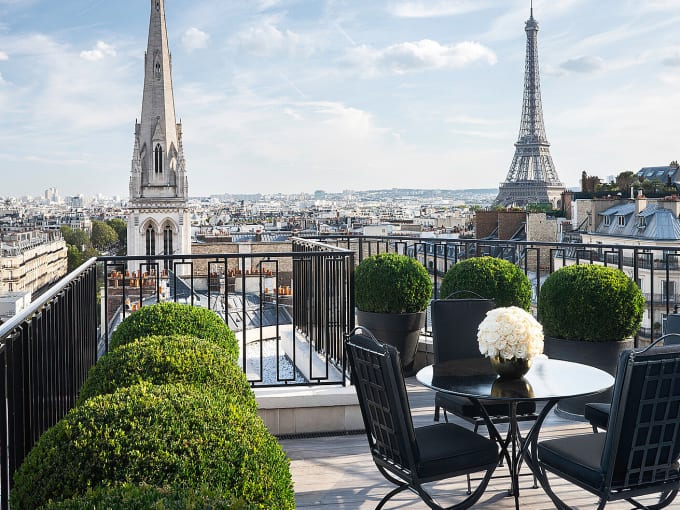
In Paris, the 8th arrondissement embodies a very particular concept of the urban hotel. It is less about isolating oneself from the world and more about fully inhabiting it. Between Avenue Montaigne, Rue du Faubourg Saint-Honoré, Place de la Concorde, and the Golden Triangle, the address is just as important as the room. This is a neighbourhood of meetings, fashion shows, headquarters, embassies, and destination restaurants. The stay here takes on a distinctly Parisian rhythm. One walks out, crosses little, and optimises their days. For a discerning business traveller, a couple on a weekend getaway, or a frequent visitor to capitals, the 8th offers a rare density. It is also where one can almost openly observe the hierarchy of the great Parisian hotel signatures.
To establish a ranking in this segment, we first consider urban relevance. A grand hotel is not automatically a grand city hotel. We assess the quality of the location, the ease of access, and the ability to cater to multiple uses in a single day. We also observe the coherence between promise and experience. A Palace in the 8th is not judged solely on its institutional prestige; it is evaluated on the precision of service, acoustic comfort, clarity of spaces, upkeep of common areas, and consistency of the stay. We take into account established distinctions, such as the Palace label from Atout France, but do not isolate them from the rest. It is important to note that our perspective prioritises actual use. An urban hotel should simplify Paris, not complicate it.
The panorama of the 8th is more nuanced than it appears. Here, one finds historic Palaces, very luxurious newer establishments, and addresses on a more contained scale. Four Seasons George V, Hôtel de Crillon, Hôtel Le Bristol Paris, La Réserve Paris – Hotel and Spa, Plaza Athénée Paris, and Le Royal Monceau Raffles Paris each embody a distinct interpretation of the Parisian stay. Bulgari Hotel Paris offers a more contemporary narrative. Prince de Galles and Hôtel de Sers appeal to those seeking a more discreet address. Fouquet’s Paris and Hôtel Barrière Le Fouquet's Paris thrive on an energy deeply rooted in the Champs-Élysées. Even Château des Fleurs, more recent to the landscape, reminds us that the 8th is not solely defined by palatial tradition.
The trends for 2025-2026 confirm several strong expectations. The first concerns intimacy in a highly exposed environment. Travellers want to remain in the centre but without enduring the hustle and bustle of the area. This elevates hotels capable of offering clear circulation, well-isolated suites, and dining spaces frequented by local clientele. The second trend is versatility. The same stay should accommodate a morning meeting, a business lunch, a wellness break, and a formal dinner. Thirdly, there is an aesthetic grounding. Clients are seeking less a demonstrative decor and more a readable identity. What our advisors observe is a growing demand for hotels that embrace their own language. Classic heritage, contemporary design, or residential spirit—all work, provided they are maintained with consistency.
French luxury in the 8th is never merely about ostentation. It rests on a more subtle grammar. The façade matters, of course, as does the sense of arrival. But the true level is measured elsewhere. In how a concierge understands a tight schedule. In a palace's ability to provide calm just minutes from the busiest thoroughfares. In the balance between ceremony and naturalness. Paris excels when service remains visible without becoming burdensome. The 8th offers several variations of this. Some establishments cultivate grand classicism, others a sharper modernity, and still others an almost residential spirit. My advice for understanding this neighbourhood is simple: pay less attention to external symbols and more to how the hotel organises your time, your movements, and your breathing.
This ranking does not seek to designate one hotel as universally superior to others. It offers an editorial hierarchy for a specific use, that of the best urban hotel in Paris 8th. An iconic Palace may be ideal for a first Parisian stay. A more understated address will suit a regular visitor better. A very social hotel will be perfect for experiencing the neighbourhood from within. Another, more secluded, will better serve rest and confidentiality. We do not penalise those absent from the Top 6. We distinguish the establishments that, according to our criteria, most clearly express the urban promise of the 8th today. This is a concierge's perspective. It prioritises the alignment between place, rhythm, service, and travel style. Each ranked hotel has its audience. This is precisely what makes this neighbourhood so exciting.
Now, let us turn to the Top 6. Here you will find institutions, very Parisian signatures, and establishments whose address is already part of the journey.