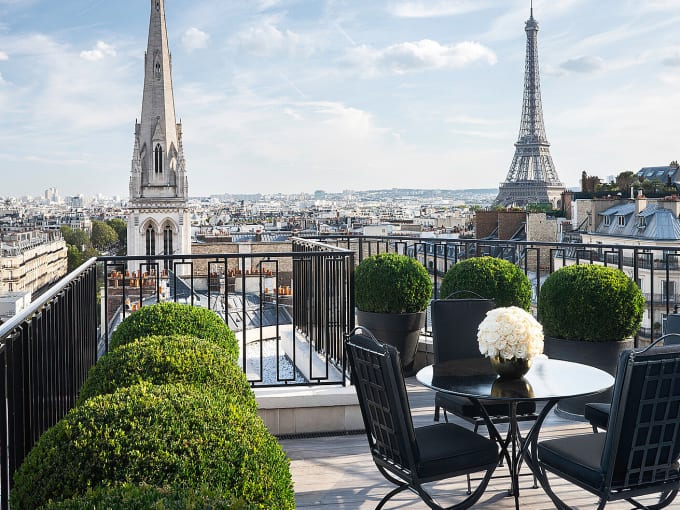
In Paris, the 8th arrondissement is home to a significant portion of the five-star hotel scene. Here, the Avenue Montaigne, the Champs-Élysées, the Faubourg Saint-Honoré, and the Place de la Concorde converge. Few locations in the world boast such a concentration of renowned establishments within such a compact area, attracting international travellers. This is a destination for fashion, the headquarters of prestigious brands, galleries, embassies, and a certain vision of the Parisian experience. The 8th is not merely a prestigious district; it is a territory of styles. Between historic palaces and more contemporary five-star hotels, it offers various interpretations of urban luxury. For a traveller, this makes all the difference. The sought-after experience can be heritage-focused, contemporary, discreet, social, or heavily wellness-oriented.
At MyConciergeHotel, we never view a ranking as a mere aggregation of reputations. Our method is grounded in verifiable facts. We consider the official category, the Palace recognition where applicable, the precise location, the brand's consistency, and the clarity of the experience. We also assess the perceived quality of service, the coherence between architecture, rooms, dining, spa, and communal spaces. A grand hotel may impress without being suitable for every stay. Conversely, a more intimate establishment may be perfectly tailored for a weekend in Paris. What our advisors particularly note is the alignment between promise and reality. In the 8th, this nuance is crucial. Travellers often hesitate between an iconic address, a discreet retreat, and a more social, visible hotel.
The landscape of the 8th is remarkable for its diversity. Four Seasons Georges V, Plaza Athénée Paris, Hôtel Le Bristol Paris, La Réserve Paris – Hotel and Spa, Le Royal Monceau Raffles Paris, and Hôtel de Crillon each embody a different grammar of luxury. Some rely on a long history and an immediately identifiable address. Others focus on a more contemporary aesthetic, sometimes more international in its language. Bulgari Hotel Paris, for instance, conveys a very modern vision of luxury, firmly rooted in the brand's universe. Prince de Galles retains a precious Art Deco resonance in this sector. Hôtel de Sers offers a more intimate scale. Fouquet’s Paris and Hôtel Barrière Le Fouquet's Paris highlight, depending on the designation, the strength of a location directly adjacent to the Champs-Élysées. Even a five-star hotel without Palace status can find its place if its positioning is clear.
For 2025 and 2026, several trends are emerging in this Parisian micro-market. The first is the quest for intimacy. Travellers accustomed to large hotels are seeking greater privacy, well-designed suites, and smoother circulation. The second concerns wellness. The spa is no longer an ancillary service; it has become a criterion for choice, on par with location. The third relates to design. Clients desire identifiable spaces, but not ostentatious ones. They expect a clear visual signature without sacrificing usability. Finally, dining remains central, but it is no longer the sole focus. A hotel in the 8th must now seamlessly integrate multiple functions. It should serve as an efficient Parisian base, a meeting backdrop, a refuge after a day in the city, and sometimes a destination in its own right. My advice is simple: choose according to your pace of stay, not just the prestige of the name.
French luxury in the 8th arrondissement is not merely about show. It rests on more subtle codes. A frictionless arrival. A quiet room despite the urban density. Impeccable bedding. A team capable of anticipating needs without being intrusive. A restaurant frequented as much for its consistency as for its reputation. This district also showcases a very Parisian dialogue between heritage and modernity. On one side, façades, salons, perspectives, and décor that recall the long hotel history of the capital. On the other, very concrete contemporary expectations. Connectivity, wellness spaces, family suites, security, discretion, and flexibility. What our advisors often observe is that the best stays arise from a good accord between the traveller and the personality of the establishment. Paris rewards precise choices, especially in such a codified arrondissement.
Thus, this ranking should be read without automatic reflexes. Being first does not mean being universal. Being sixth does not mean being secondary. Each hotel in the 8th attracts a distinct audience. Some travellers wish to experience a Parisian institution, with all the rituals, highly structured service, and international recognition that entails. Others prefer a more intimate address, where they feel quickly at home. Still others seek a more contemporary energy, close to fashion, shopping, and business meetings. We have prioritised overall coherence, the strength of the address, and the hotel's ability to represent the best of Parisian five-star hospitality in its own right. We do not oppose historic establishments to more recent openings; rather, we aim to distinguish those that sustainably uphold their promise.
The following Top 6 should therefore be viewed as a selection of references, not as a definitive verdict. It highlights hotels capable of structuring a stay in Paris 8e. It is also important to note that the right choice depends on the purpose of the trip. Cultural getaway, fashion week, business meeting, anniversary, wellness retreat, or first-time visit to Paris do not always call for the same address.