History & heritage
Gran Hotel Manzana Kempinski La Habana belongs to a part of Havana where architecture alone tells several layers of Cuban history. Set within a historic building in the old centre, the hotel does not attempt to stage an artificial version of the past; it relies instead on a genuine urban structure, on volumes inherited from another era, and on an address that is fully part of the district’s memory. This heritage dimension is essential to understanding the property. Here, luxury rests not only on contemporary comfort or polished service, but on the very particular feeling of inhabiting, for the duration of a stay, a piece of the city shaped by continuity.
The name itself recalls Havana’s tradition of grand urban buildings, originally conceived as places of movement, exchange and civic life. In this part of the capital, monumental façades, arcades, open perspectives onto squares and animated streets form more than a backdrop. Gran Hotel Manzana Kempinski La Habana sits within this fabric with an almost institutional presence, as an address that looks both to the city’s history and to its present. Its interest lies precisely in this balance: preserving the spirit of an old building while adapting it to the expectations of an international five-star hotel.
Inside, this reading of heritage continues through elegant shared spaces where refinement remains measured. One finds the idea of a classical Havana, expressed through generous proportions, durable materials and a certain luminous gravity, without unnecessary decorative excess. The colonial charm often mentioned by travellers should not be understood as a frozen set, but as an atmosphere: that of a building that has retained a strong relationship with its urban surroundings, with Caribbean light, with the rhythms of the city and with a culture of hospitality deeply rooted in the Hispanic world.
The Kempinski name adds another layer. It places the hotel within a European hospitality tradition attentive to service, discretion and the enhancement of historic settings. In Havana, that encounter creates a singular identity: neither an isolated resort-style palace nor a mere city hotel, but an address that fully embraces its position in the heart of the capital. For the traveller, this means an experience in which one does not stay beside Havana, but truly within its cultural depth.
This sense of heritage is also felt in the way the hotel relates to the major landmarks around it. Historic central Havana is an urban ensemble in which monuments, institutions, promenades and squares form a coherent landscape. Staying here means entering a city best discovered on foot, through successive details: a balcony, worn stone, a view towards a dome, a restored façade, a street where music drifts from an open doorway. Gran Hotel Manzana Kempinski La Habana draws much of its strength from this immersion. Its story is not only that of a restored building; it is that of an address that allows Havana to be read through architecture, rhythm and permanence.
The hotel
What first stands out at Gran Hotel Manzana Kempinski La Habana is the way it occupies central Havana with calm assurance. In a city known for its visual, sonic and human intensity, the hotel offers an ordered counterpoint without ever cutting itself off from the energy outside. This relationship between urban animation and controlled retreat is part of its identity. One enters to find a more muted tempo, fluid circulation and spaces designed for pause, while keeping within immediate reach the streets, squares and landmarks that give the Cuban capital its distinctive density.
The historic building lends the whole a rare sense of grounding. The volumes seem made to let light breathe, and the shared spaces play an important role in the stay. They are not merely transitional areas: they establish an atmosphere. Lounges, corridors, reception zones and meeting spaces are handled with an elegance that favours clarity over effect. This restraint suits the property well. It allows the place to assert itself without excess, and reminds one that true luxury in a heritage setting often lies in the quality of proportions, quiet comfort and overall coherence.
The hotel also appeals through its ability to suit different kinds of travellers. A couple will find a refined base from which to explore the city and return at day’s end to a calmer setting. A business traveller will appreciate the central location, the structured service and the ease of moving around the centre. Lovers of architecture, meanwhile, will see it as a privileged vantage point over historic Havana. This versatility does not dilute the property’s identity; it strengthens it. Gran Hotel Manzana Kempinski La Habana is not a themed hotel, but a fully realised city address, capable of accommodating several uses without losing its tone.
Location is one of its clearest assets. To be in the heart of Havana means being able to shape one’s days with flexibility: setting out early to discover the streets while they are still cool, returning for a pause in the middle of the day, heading out again at sunset, or extending the evening nearby without relying on complicated logistics. This simplicity changes the quality of a stay. It allows the city to be experienced more organically, less rigidly planned, with room for the unexpected — an open church, a gallery, a lively square, a café, an impromptu walk.
The property also cultivates a form of serenity that never feels impersonal. Service, round-the-clock reception, concierge support and the general organisation all contribute to a sense of discreet guidance. In a destination where practical bearings may sometimes feel fluid to an international visitor, that stability has real value. It allows guests to enjoy Havana’s intensity without unnecessary fatigue. In this sense, Gran Hotel Manzana Kempinski La Habana delivers what one expects from a contemporary grand city hotel: an elegant, reliable and well-structured setting, while allowing the city itself to remain the true protagonist of the journey.
Rooms and suites
In a hotel of this calibre, the room is not merely a place to sleep: it becomes a space of decompression after the city. At Gran Hotel Manzana Kempinski La Habana, that function takes on particular meaning. Havana intensely engages the eye and the attention; one walks a great deal, observes constantly, moves from square to street, from façade to perspective, from silence to music. Returning to one’s room should therefore create a sense of re-centring. That is what one expects here: interiors conceived for rest, coolness, privacy and continuity of comfort, rather than decorative display.
The dialogue between architectural heritage and contemporary standards is especially relevant in the accommodation. In a historic building, a successful room must respect the constraints of the place while ensuring a seamless experience for today’s traveller. That generally means generous proportions where the architecture allows, attention to visual and acoustic calm, bathrooms designed for comfortable use, and bedding in keeping with a five-star property. More than that, it requires a certain legibility of space: the ability to unpack, work for a while, read, get ready for dinner or simply watch the light change without anything feeling contrived.
Rooms and suites in a grand city hotel such as this must also respond to varied patterns of use. Some travellers will spend little time in them, preferring to devote their days to exploring the city. Others, by contrast, will enjoy long pauses away from the heat or external animation. In both cases, the quality of accommodation is measured by its adaptability. A good armchair, a functional desk, sufficient storage, rigorous daily housekeeping and turndown service all contribute to the impression of a well-run stay. These are details, but they are the details that turn a fine address into a genuine refuge.
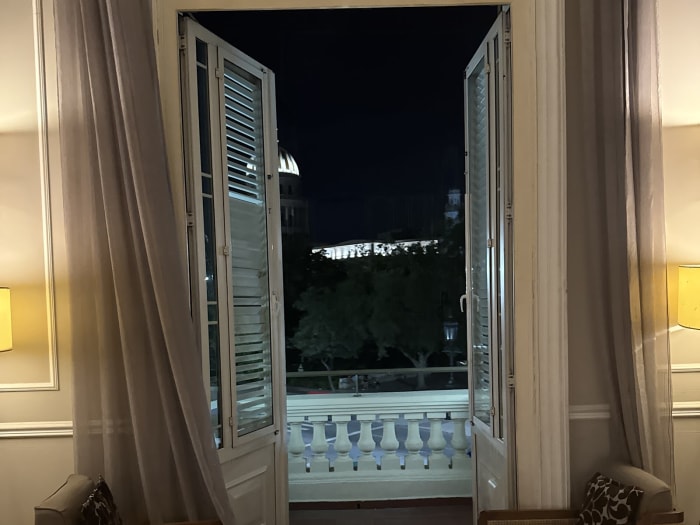
In Havana, the view can also matter. Without promising any particular panorama where this is not explicitly documented, one can say that a well-positioned room in the historic centre often offers a valuable relationship with the city: the sense of being above the movement, of observing the urban fabric from a slight remove, of seeing tropical light fall across stone and rooftops. Even discreetly, that visual connection contributes to the experience. It reminds guests that they are staying in a hotel deeply rooted in its surroundings, not in an interchangeable environment.
Finally, the true comfort of a grand hotel room lies in the invisible quality of how it functions. Daily housekeeping, attentive staff, reception available at all hours and precise organisation create a reassuring continuity. After a day spent discovering Havana, that reliability matters as much as aesthetics. It allows the stay to remain fluid, whether for a short stop, a business trip or a longer interlude. At Gran Hotel Manzana Kempinski La Habana, rooms and suites are best understood as spaces of urban breathing room: elegant, well maintained, attuned to the city and its rhythm, while never losing sight of the essential purpose, which is to welcome well.
Dining
In a grand city address, dining often serves a double purpose: it meets the practical needs of a stay and contributes to the reading of the place. At Gran Hotel Manzana Kempinski La Habana, dining should be understood in that framework. Guests come first for the convenience of a well-organised breakfast, for lunch between appointments or after a morning of sightseeing, for dinner without leaving the centre, or for a more informal moment over a drink. Yet beyond this function, the culinary experience of a hotel in the heart of Havana carries a particular resonance. It belongs to a city where Spanish, Caribbean and international influences have shaped varied dining habits, often marked by rhythm, conviviality and a fondness for places open to the street.
Without asserting unverified details about the hotel’s restaurants or culinary signatures, one can say that a five-star property of this kind is expected to deliver on several fronts. The first is consistency. For an international traveller, knowing that one will find reliable service, careful execution and a comfortable setting at the right times matters greatly. The second is atmosphere. In a historic building, dining becomes more compelling when it extends the architectural identity of the place rather than working against it. That depends on light, materials, the relationship with the shared spaces and the way service accompanies the moment without weighing it down.
Breakfast, in particular, is often revealing. In a city such as Havana, where days begin early to make the most of softer light and calmer streets, it acts as a departure ritual. Fruit, hot drinks, savoury or sweet dishes, attentive but unobtrusive service: this first meal sets the tone. It should allow for both efficiency and pleasure, whether one is heading to a meeting, an architectural walk or a more leisurely day. In a centrally located hotel, it also simplifies the stay by providing a stable point of anchorage before one gives oneself over to the city.
The rest of the day calls for other uses. Lunch at the hotel can become a welcome pause when the heat intensifies. Dinner on site makes equal sense after a full day, when one wishes to extend the evening in a controlled setting. As for the bar or lounge, where they exist in the spirit of a grand hotel, they often play a discreet but essential role: that of a transitional space between outside and inside, between the city and intimacy, between the animation of travel and a return to calm.
In Havana, dining is never entirely about the plate alone. It also involves a certain way of inhabiting time. Having coffee, lingering a little, watching people come and go, meeting one’s travelling companions, planning the next part of the day or simply taking a pause: all of this belongs to the experience. Gran Hotel Manzana Kempinski La Habana, through its location and standing, naturally lends itself to that rhythm. Dining here is less a display than an essential service well integrated into the whole, in support of a stay that is fluid, elegant and deeply urban.
Spa & Well-being
In a city as dense and stimulating as Havana, well-being takes on a particular significance. It provides a counterpoint to the intensity of travel.
Wandering through the historic centre, visiting, observing, and listening also requires moments of respite. In a five-star hotel, spaces dedicated to well-being cater to this need.
They allow guests to slow down, regain freshness, and rebalance their stay between exploration and recovery.
The quality of moments of pause is also a measure of an establishment of this calibre. Treatment rooms, relaxation facilities, and an environment conducive to rest all contribute to this.
In the Caribbean context, this aspect is even more appreciated. The climate, the light, and the rhythm of the city invite one to alternate between exploration, calm, and rest.
Well-being is not separate from the rest of the experience; it is its natural extension.
A massage after a day of walking, a moment of tranquillity before dinner, or an afternoon break significantly enhance the journey. In a grand urban hotel, a wellness area should remain easily accessible.
One seeks a soothing atmosphere, professional hospitality, and genuine recovery.
This approach to care also extends to less visible elements. The quality of bedding, turn-down service, daily room maintenance, and the smoothness of requests are equally important.
A successful stay does not solely depend on a spa; it rests on a coherent chain of comfort.
This is particularly true in Havana, where visitors come as much to experience the city as to relax. The hotel must facilitate both.
Finally, urban well-being also has a contemplative dimension. Taking the time to slow down and let the hustle and bustle settle is part of the stay.
The Gran Hotel Manzana Kempinski La Habana lends itself to this alternation between immersion and retreat. Its approach to well-being relies on discreet and effective recovery resources.
Concierge & services
The calibre of a grand hotel is often measured less by what it displays than by the way it supports. At Gran Hotel Manzana Kempinski La Habana, this service dimension is central, all the more so because the property welcomes both leisure travellers and business guests. In both cases, the quality of the experience depends largely on organisational fluidity. A round-the-clock front desk, 24-hour concierge, multilingual staff, rigorous handling of arrivals and departures, luggage storage, wake-up service, laundry, daily housekeeping and turndown service form a concrete foundation. These are services sometimes taken for granted in high-end hospitality, yet their true value becomes clear when they operate with discretion and consistency.
In a destination such as Havana, this know-how takes on particular importance. For an international visitor, the practical organisation of a stay may require more anticipation than elsewhere: transfers, timings, local bearings, the rhythm of the city and the management of sightseeing time. Concierge support therefore becomes much more than a simple information desk. It acts as an interface between traveller and city, helping to structure the stay without weighing it down. Arranging a transfer in advance, confirming a car, suggesting a coherent itinerary for a first discovery of the centre, advising on the right time to set out on foot or helping shape a smoother day: these are service gestures that genuinely change the experience.
Round-the-clock availability is equally valuable in a city hotel. Late arrivals, early departures, last-minute requests and programme adjustments are part of the reality of travel. When a property can absorb these variations without friction, it immediately gains credibility. This ability to remain reliable whatever the hour is one of the surest markers of a well-run address. It reassures, simplifies and allows the guest to focus on what matters: the stay itself, meetings, discoveries.
Daily housekeeping and turndown service also contribute to this impression of continuous care. They are not only matters of material comfort; they create rhythm. The room is reset, prepared for evening and kept in a state of order that supports the overall quality of the stay. Laundry and luggage storage answer very practical needs, particularly useful on longer itineraries or stays combining business and leisure. As for multilingual staff, they make exchanges simpler, more precise and more relaxed.
Ultimately, the concierge and services at Gran Hotel Manzana Kempinski La Habana should be understood as the invisible infrastructure of a successful trip. They do not seek to draw attention to themselves; they ensure continuity. In a place where guests come to experience Havana intensely while benefiting from a structured setting, this quality of support makes all the difference. It allows the hotel to be not only a fine address, but a genuine point of reference: reliable, elegant and attentive, from first contact to departure.
The art of living in Havana
Staying at Gran Hotel Manzana Kempinski La Habana means choosing a particular way into Havana: through its centre, through its built memory and through its daily rhythms. The city does not reveal itself as a uniform backdrop. It is discovered through contrasts, through successive intensities, through details that gather meaning as one moves along. A shaded square, a monumental façade, a line of arcades, a more popular street, an ornate balcony, a vintage car, an animated conversation, music appearing without warning: Havana’s art of living lies in this coexistence of urban grandeur and spontaneity. From such a central address, one can approach it especially directly.
The first luxury here is the ability to walk. Central Havana lends itself to attentive, almost cinematic exploration on foot. One notices the changing light through the day, the way buildings hold the heat, the movement of residents, pauses in the squares, thresholds opening onto homes or shops. A well-located hotel allows this experience to unfold without excessive mediation. One goes out, explores, returns, then sets out again. This freedom of composition gives the stay a rare quality: that of not being entirely programmed.
Havana is also a city of temporalities. Morning does not resemble late afternoon, and evening opens yet another atmosphere. Early on, the city can feel softer, almost restrained. Later, it gains density, warmth and traffic. In the evening, certain streets change tone, terraces fill and music becomes more present. Staying in the heart of this dynamic makes it possible to perceive these nuances rather than receive a simplified image of the city. The hotel then acts as a stable anchor point within a place in constant movement.
Havana’s art of living also involves a highly visible sociability. People talk in the street, stop, watch, listen. Even for a passing visitor, this relational dimension is perceptible. It does not necessarily require continuous interaction to be felt; often it is enough simply to be there, attentive and available to the urban spectacle. From a grand hotel, this immersion can be experienced with welcome comfort: one enjoys the intensity outside while knowing that a calm, organised and elegant setting awaits afterwards.
Finally, Havana should not be reduced to a heritage destination alone. It is a lived-in, complex, vibrant city, sometimes contradictory, always expressive. The best way to approach it is often to accept that plurality. Gran Hotel Manzana Kempinski La Habana is particularly suited to that approach because it does not place the traveller at a distance. It situates the guest at the centre of the urban narrative, in a historic building that echoes the city itself. For those seeking more than simple accommodation — an address capable of giving shape to the Havana experience without softening it — the hotel offers a relevant, comfortable and deeply rooted point of departure.
Book with MyConciergeHotel
Booking Gran Hotel Manzana Kempinski La Habana through MyConciergeHotel means approaching the stay in the right way: with clear preparation, human guidance and attention to the details that truly matter. In a destination such as Havana, the value of a well-managed booking goes beyond the simple confirmation of a room. It also involves anticipating the practical aspects of travel, choosing the right rhythm for the stay and securing the logistical elements that can make a real difference on arrival. A central historic hotel such as this deserves to be considered in context: ideal length of stay, transfer arrangements, balance between exploration and rest, and any expectations linked to the traveller’s profile.
For a couple, the priority will often be a seamless experience, with a stress-free arrival, accommodation suited to an urban stay and the ability to make the most of the historic centre. For a business traveller, it may be about optimising logistics, ensuring a late arrival is handled smoothly, planning useful services on site and preserving flexibility. For a first stay in Havana, guidance becomes even more valuable: knowing exactly where one is staying, understanding how the district works, preparing the first movements and avoiding unnecessary uncertainty all help the trip begin well.
This is precisely the layer of clarity that MyConciergeHotel brings. The aim is not to overcomplicate the stay with mediation, but to make it simpler and more coherent. A well-framed request in advance helps identify priorities: airport transfer needs, a preference for a stay focused on exploring on foot, the search for a calm setting after active days, or the need for consistent services during a business trip. This tailored approach is especially relevant for a property such as Gran Hotel Manzana Kempinski La Habana, whose value lies as much in its location and atmosphere as in the quality of its daily functioning.
Booking with support also means calibrating expectations more accurately. One is choosing here a grand urban address in the heart of the capital, within a historic building, with all that implies in terms of immediate proximity to the city, architectural richness and structured comfort. It is not a beach retreat or an isolated resort; it is an elegant and efficient way to experience Havana from one of its key urban points. That distinction matters, because it helps turn a good booking into a genuinely successful stay.
Finally, the simplest advice is often the most useful: anticipate the arrival. Booking an airport transfer in advance allows the journey to begin with greater peace of mind, especially after a long trip. This is exactly the kind of detail that MyConciergeHotel helps integrate from the planning stage. Ultimately, booking through MyConciergeHotel means choosing an experience that is clearer, smoother and better supported, in keeping with what Gran Hotel Manzana Kempinski La Habana promises: a five-star address in the heart of Havana, where elegance of setting should always go hand in hand with ease of stay.