Histoire & esprit des lieux
The Fearrington House s’inscrit dans une idée de l’hospitalité américaine qui privilégie le rythme, l’attention et la continuité plutôt que l’effet. À Pittsboro, dans un environnement rural qui fait partie intégrante de l’expérience, l’adresse cultive une forme d’élégance domestique rare : celle d’une maison de caractère devenue hôtel, sans perdre le sentiment d’intimité qui fait le charme des grandes demeures bien tenues. Le fait qu’elle appartienne à l’univers Relais & Châteaux donne un cadre de lecture clair : ici, le séjour ne se résume pas à une chambre, mais à une manière d’habiter un lieu, de le parcourir, de s’y attarder, d’en adopter les usages.
L’identité de la maison repose d’abord sur son atmosphère. On y retrouve une inspiration puisée dans le Sud des États-Unis, non comme décor de circonstance, mais comme langage esthétique et culturel. Cela se traduit par une certaine douceur dans les volumes, une palette accueillante, des intérieurs pensés pour la conversation, la lecture, le repos, et une relation très naturelle entre la maison et ses jardins. Le raffinement ne cherche pas à impressionner ; il se manifeste dans la qualité des matières, dans l’équilibre des espaces, dans cette sensation de cohérence qui distingue les établissements ayant une véritable personnalité.
L’adresse parle aussi à une tradition du voyage plus lente, plus choisie. On vient à Fearrington House pour faire une pause, pour retrouver une temporalité moins fragmentée, pour vivre quelques jours dans un cadre où tout semble organisé pour réduire le bruit du quotidien. Le contexte rural de Pittsboro joue ici un rôle essentiel. Il ne s’agit pas d’un isolement spectaculaire, mais d’une campagne habitée, paisible, qui donne au séjour une respiration particulière. Les jardins autour de la maison prolongent cette impression : ils ne sont pas seulement un agrément visuel, mais une transition sensible entre l’architecture, la lumière et les saisons.
Cette dimension presque résidentielle explique pourquoi l’hôtel séduit particulièrement les couples et les voyageurs en quête d’une escapade romantique. Le romantisme, ici, n’est pas théâtral. Il naît de la discrétion du service, du calme des espaces, de la possibilité de se retrouver sans programme imposé. Un petit-déjeuner pris sans hâte, une promenade dans les jardins, un retour en chambre en fin d’après-midi, un dîner qui structure la soirée : autant de gestes simples qui prennent une autre valeur lorsqu’ils sont soutenus par un lieu juste.
Dans un paysage hôtelier souvent dominé par l’instantané et la démonstration, The Fearrington House défend au contraire une idée durable du luxe. Un luxe de précision, de confort et d’attention, où l’on sent moins la volonté de séduire que celle de recevoir. C’est sans doute ce qui donne à l’établissement sa profondeur : la sensation d’entrer dans une maison qui a trouvé son ton, et qui n’a pas besoin d’en changer pour rester désirable.
L’établissement
Ce qui distingue immédiatement The Fearrington House, c’est la qualité de son implantation. À Pittsboro, l’hôtel prend place dans un cadre rural qui n’a rien d’un simple arrière-plan. Ici, le paysage participe pleinement à l’expérience de séjour. On perçoit dès l’arrivée une forme de relâchement : l’espace s’ouvre, les sons se raréfient, la végétation reprend sa place, et la maison apparaît comme un point d’ancrage élégant au milieu d’un environnement apaisé. Pour les voyageurs habitués aux grandes destinations urbaines, cette respiration constitue déjà un luxe en soi.
L’architecture et les extérieurs travaillent ensemble pour créer une impression de continuité. Les jardins entourant la maison ne sont pas conçus comme un décor séparé, mais comme l’extension naturelle des espaces intérieurs. Ils accompagnent les circulations, adoucissent les perspectives et invitent à ralentir. Selon la saison, ils modifient subtilement la perception du lieu : lumière plus tendre au printemps, densité végétale en été, tonalités plus feutrées lorsque l’année avance. Cette relation au temps long, aux variations du climat et à la vie du jardin contribue fortement au caractère de l’adresse.
À l’intérieur, la décoration inspirée du Sud des États-Unis donne le ton. Il ne s’agit pas d’une reconstitution historique ni d’un folklore appuyé, mais d’une interprétation élégante d’un certain art de recevoir : pièces confortables, lignes classiques, détails soignés, ambiance chaleureuse. Le résultat est particulièrement convaincant parce qu’il évite deux écueils fréquents dans l’hôtellerie haut de gamme : la froideur des lieux trop conceptuels et la surcharge des décors trop démonstratifs. Fearrington House préfère la mesure. On s’y sent accueilli, non impressionné.
Cette sensation de maison habitée est essentielle. Elle transforme la circulation dans l’hôtel en expérience presque résidentielle. On passe d’un salon à un couloir, d’une chambre à un jardin, d’un espace de repas à un coin plus retiré avec la même fluidité que dans une demeure privée. Pour un séjour à deux, cette échelle humaine compte beaucoup. Elle favorise l’intimité, permet de s’approprier les lieux rapidement et donne au séjour une tonalité plus personnelle qu’institutionnelle.
Le calme est un autre élément structurant. Dans un établissement pensé pour la détente, le silence n’est pas une absence mais une qualité. Il rend possible un autre rapport au temps : lire plus longtemps, prendre un café sans regarder l’heure, prolonger une conversation, revenir en chambre dans l’après-midi sans avoir l’impression d’interrompre quoi que ce soit. Cet usage libre du lieu explique en grande partie l’attachement que suscite l’adresse auprès des voyageurs en quête de sérénité.
Enfin, The Fearrington House réussit un équilibre délicat entre raffinement et simplicité. Rien n’y paraît forcé. Le cadre rural, les jardins, l’esprit de maison, la décoration méridionale américaine et le service attentif composent un ensemble cohérent, lisible, durable. C’est cette cohérence qui fait la valeur du lieu : non pas l’accumulation d’éléments luxueux, mais leur juste articulation. On ne vient pas seulement y dormir ; on vient y retrouver une certaine idée du confort, plus profonde parce qu’elle est calme.
Chambres et suites
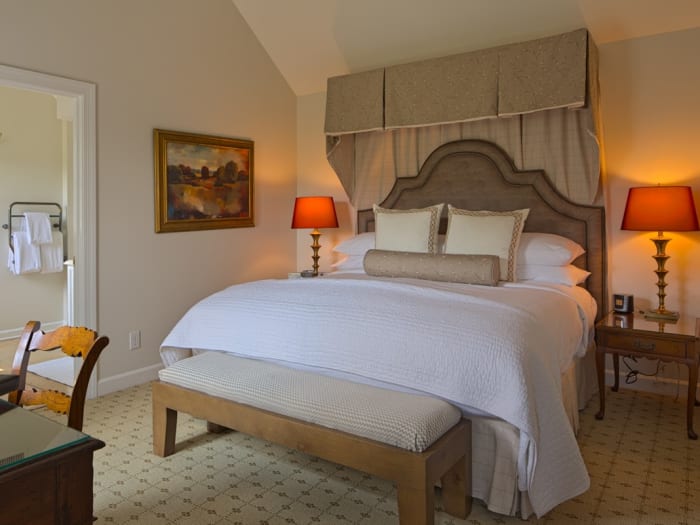
À The Fearrington House, l’expérience de la chambre prolonge très naturellement celle de la maison. On n’y cherche pas l’effet spectaculaire ni la démonstration décorative ; on y retrouve plutôt cette idée, très juste, d’un confort construit dans la durée. Les chambres et suites semblent pensées pour être réellement habitées : on s’y installe facilement, on y prend ses habitudes rapidement, et l’on comprend dès les premières heures que le repos n’est pas ici un argument marketing, mais une intention concrète.
L’inspiration du Sud des États-Unis, déjà perceptible dans les espaces communs, se décline dans les hébergements avec une retenue bienvenue. Les lignes, les matières et l’ambiance privilégient la chaleur plutôt que la théâtralité. Cela crée des intérieurs qui rassurent immédiatement, sans jamais tomber dans la banalité. Dans l’hôtellerie de haut niveau, cette qualité est plus rare qu’il n’y paraît : beaucoup d’adresses savent produire du luxe visible, moins nombreuses sont celles qui savent créer un sentiment d’évidence. Fearrington House appartient à cette seconde catégorie.
Le rapport à la lumière joue un rôle important. Dans une propriété entourée de jardins et inscrite dans un cadre rural, la chambre n’est pas conçue comme une boîte fermée mais comme un refuge en dialogue avec l’extérieur. Selon le moment de la journée, la lumière transforme les textures, accompagne les temps de pause et renforce cette impression de séjourner dans une maison de campagne raffinée plutôt que dans un hôtel standardisé. Pour les voyageurs qui apprécient les lieux où l’on peut aussi bien sortir que rester, cet équilibre est particulièrement réussi.
Le confort quotidien est soutenu par des services qui comptent réellement dans l’expérience. Le service de chambre quotidien maintient les espaces dans un état irréprochable sans perturber le rythme du séjour. Le service de couverture, lui, participe à cette sensation très particulière d’être attendu, accompagné, pris en charge avec délicatesse. Ce sont des gestes discrets, mais ils changent la perception d’une fin de journée : on revient dîner ou se promener, puis l’on retrouve une chambre préparée pour la nuit, plus calme encore, presque recentrée sur sa fonction essentielle de retraite.
Pour un séjour romantique, les chambres et suites jouent un rôle central. Elles offrent le cadre d’un temps partagé qui n’a pas besoin d’être constamment animé. Lire côte à côte, commander un réveil à l’heure souhaitée, laisser les bagages pris en charge, revenir après une promenade dans les jardins : ces détails composent une expérience de couple fondée sur la fluidité. Le luxe, ici, réside dans l’absence de friction. Tout semble organisé pour que l’attention se porte sur la personne avec qui l’on voyage, et non sur la logistique du séjour.
Les voyageurs en quête d’une escapade paisible apprécieront aussi cette capacité des chambres à protéger du monde extérieur sans couper du lieu. On s’y sent retiré, mais jamais isolé ; enveloppé, mais jamais enfermé. C’est une nuance importante, et l’une des raisons pour lesquelles l’adresse fonctionne aussi bien pour les courts séjours que pour des parenthèses plus longues. Une bonne chambre ne se contente pas d’être belle : elle doit tenir dans le temps, accompagner différents usages, rester agréable du matin au soir. À The Fearrington House, cette promesse est au cœur de l’expérience.
La table
Dans une maison membre de Relais & Châteaux, la table occupe toujours une place particulière. À The Fearrington House, elle s’inscrit dans la même logique que le reste du séjour : une recherche de justesse, de rythme et de plaisir durable plutôt qu’une volonté d’en mettre plein la vue. Même sans multiplier les effets d’annonce, l’adresse laisse entendre une certaine idée de la gastronomie hôtelière haut de gamme : une cuisine pensée comme un moment central de la journée, un service attentif, et un cadre qui permet au repas de devenir une véritable séquence du voyage.
Le contexte rural donne naturellement du sens à cette expérience. Dans un environnement où la nature, les saisons et le calme sont si présents, le repas prend une autre densité. On n’y vient pas seulement pour se nourrir, mais pour prolonger l’atmosphère du lieu. Le matin, cela peut signifier un début de journée plus lent, en accord avec le paysage et les jardins. Le soir, le dîner devient souvent le point d’orgue d’une journée sans agitation, une manière de rassembler les impressions du séjour dans un moment plus cérémoniel, mais jamais rigide.
Ce qui compte ici, c’est moins la performance que l’accord entre la cuisine, le service et le décor. Dans les meilleures maisons, la gastronomie ne se vit pas comme un exercice séparé du reste de l’hôtel. Elle doit parler le même langage que les chambres, les salons, les jardins. À Fearrington House, tout laisse penser que cette cohérence est précisément l’un des grands atouts de l’adresse. Le repas s’inscrit dans un ensemble : on passe d’une promenade à un apéritif, d’un salon à la table, puis de la table à la chambre avec une continuité qui renforce la sensation de séjour complet.
Pour les couples, cette dimension est essentielle. Une escapade romantique réussie tient souvent à la qualité de ses transitions : ne pas avoir à quitter brutalement l’univers du lieu pour dîner, pouvoir prolonger la soirée dans un cadre calme, retrouver ensuite une chambre préparée avec soin. La table devient alors plus qu’un restaurant ; elle devient un élément de mise en scène douce du séjour. Elle structure la journée sans l’alourdir, offre un moment de partage sans imposer de solennité excessive.
L’appartenance à Relais & Châteaux suggère également une attention particulière portée au sens de l’accueil à table. Cela se traduit habituellement par une connaissance précise des attentes des hôtes, une capacité à accompagner les préférences individuelles et un service qui sait rester présent sans jamais devenir intrusif. Dans une maison de cette nature, l’expérience gastronomique réussit lorsqu’elle donne le sentiment que tout est simple, alors même que cette simplicité repose sur une organisation très maîtrisée.
Enfin, la table de The Fearrington House participe à cette idée plus large d’un luxe rural contemporain. Un luxe qui ne se définit pas par l’ostentation, mais par la qualité de l’expérience vécue : prendre le temps, être bien reçu, manger dans un cadre qui a du sens, sentir que le repas appartient réellement au lieu. Pour les voyageurs qui choisissent Pittsboro précisément pour cette respiration, la dimension gastronomique n’est pas un supplément ; elle est l’un des moyens les plus évidents de comprendre l’esprit de la maison.
Conciergerie & services
Dans une adresse comme The Fearrington House, le service ne se mesure pas à sa visibilité mais à sa précision. Le véritable luxe n’est pas d’être sollicité en permanence ; c’est de sentir que tout est prêt, que les besoins ont été anticipés, et que l’on peut se consacrer entièrement à son séjour. Cette philosophie se lit dans les services connus de l’établissement, qui dessinent une hospitalité complète, fluide et discrète, particulièrement adaptée à une clientèle venue chercher le calme plutôt que l’animation.
La présence d’une conciergerie 24h/24 et d’une réception ouverte en continu constitue d’abord une garantie de sérénité. Pour des voyageurs arrivant tard, organisant un week-end à deux ou souhaitant simplement conserver une grande liberté de mouvement, cette continuité de présence change beaucoup. Elle permet d’aborder le séjour sans contrainte horaire excessive, avec la certitude de pouvoir compter à tout moment sur un interlocuteur. Dans les meilleurs hôtels, cette disponibilité ne s’impose jamais ; elle rassure silencieusement.
Le service de chambre quotidien et le service de couverture participent à cette même qualité d’accompagnement. Ils rappellent que l’expérience d’un hôtel 5 étoiles tient souvent à des gestes modestes en apparence, mais décisifs dans leur effet cumulé. Une chambre remise en ordre avec soin, un lit préparé pour la nuit, une sensation constante de fraîcheur et d’attention : autant d’éléments qui allègent le séjour et renforcent l’impression d’être véritablement reçu. Dans une maison à l’esprit résidentiel, ces services prennent une valeur particulière, car ils soutiennent l’illusion heureuse d’une demeure privée parfaitement tenue.
La consigne à bagages, la blanchisserie et le service de réveil relèvent d’un registre plus pratique, mais leur importance ne doit pas être sous-estimée. Ils permettent de voyager léger, de gérer un programme avec souplesse, de prolonger une dernière promenade ou un déjeuner sans se soucier immédiatement de la logistique. Pour un court séjour romantique, cette fluidité est essentielle : moins le couple a à penser aux détails matériels, plus le temps partagé gagne en qualité. Le service hôtelier joue alors pleinement son rôle, qui n’est pas de se montrer, mais de libérer du temps et de l’attention.
La mention d’un personnel multilingue est également significative. Elle indique une capacité à accueillir une clientèle internationale avec naturel, sans transformer l’expérience en protocole. Dans une adresse où l’atmosphère compte autant que les prestations, la qualité de l’échange humain est centrale. Être compris rapidement, pouvoir formuler une demande simplement, recevoir une réponse claire et élégante : ce sont là des aspects très concrets du confort, souvent plus mémorables que certains équipements spectaculaires.
Enfin, il faut souligner que l’ensemble de ces services prend tout son sens dans le contexte spécifique de Fearrington House. Dans un cadre rural, calme et tourné vers la détente, l’efficacité doit rester invisible. Le personnel idéal est celui qui sait être là sans interrompre, accompagner sans diriger, répondre sans alourdir. Lorsque cette alchimie fonctionne, le séjour gagne en profondeur. On ne retient pas seulement qu’un service était disponible ; on retient surtout qu’on n’a jamais eu à se battre contre l’organisation du voyage. C’est précisément cette douceur opérationnelle qui fait la différence entre un bon hôtel et une grande maison.
L’art de vivre à Pittsboro
Séjourner à The Fearrington House, c’est aussi découvrir une autre manière d’habiter le voyage aux États-Unis. Pittsboro n’est pas une destination de frénésie ni d’accumulation. Son intérêt réside au contraire dans une forme de retrait choisi, dans un rapport plus direct au paysage, dans une échelle plus humaine qui redonne de la valeur aux gestes simples. Pour une clientèle habituée aux capitales, aux stations très codifiées ou aux grands resorts, cette respiration a quelque chose de profondément régénérant.
L’art de vivre local se comprend d’abord par le rythme. Ici, l’expérience n’est pas dictée par une liste d’incontournables à cocher, mais par la qualité du temps passé. On prend le temps de marcher, de regarder, de s’installer, de revenir. Le cadre rural de Pittsboro encourage cette disponibilité intérieure. Il invite à ralentir sans jamais donner le sentiment de manquer quelque chose. C’est une nuance importante : le calme n’est pas une privation, mais un enrichissement. Il permet de mieux percevoir les détails, de mieux goûter le confort d’une chambre, la lumière dans les jardins, la qualité d’un repas ou d’une conversation.
Dans ce contexte, The Fearrington House agit comme un interprète idéal du lieu. L’hôtel ne cherche pas à s’extraire de son environnement ; il en propose une lecture raffinée. Les jardins autour de la maison, la décoration inspirée du Sud des États-Unis, l’atmosphère chaleureuse et l’attention portée au service composent une version particulièrement aboutie d’un certain art de recevoir méridional. Le voyageur n’est pas placé face à un folklore, mais invité dans une ambiance. Cette différence est essentielle : elle rend l’expérience plus crédible, plus sensible, plus durable dans le souvenir.
Pour les couples, Pittsboro offre un cadre particulièrement pertinent. Une escapade romantique n’a pas toujours besoin d’un programme spectaculaire ; elle a surtout besoin d’un lieu qui permette la présence. Ici, cette présence se construit dans les interstices : un café pris lentement, une promenade dans les jardins, un retour en chambre en milieu d’après-midi, un dîner sans précipitation, une nuit paisible. Le luxe de la destination tient à cette capacité à faire exister le temps partagé sans le surcharger.
Le rapport aux saisons ajoute encore à l’intérêt du séjour. Le printemps et l’été sont souvent appréciés pour profiter pleinement des jardins, mais chaque période de l’année peut révéler une autre facette de la maison et de son environnement. Dans les destinations rurales, les variations de lumière, de température et de végétation modifient profondément l’expérience. Elles rappellent que le voyage n’est pas seulement spatial ; il est aussi saisonnier. Revenir dans un lieu comme Fearrington House à différents moments de l’année peut ainsi produire des impressions très différentes, tout en conservant le même sentiment de cohérence.
Au fond, l’art de vivre à Pittsboro tel qu’on l’éprouve depuis The Fearrington House repose sur une idée simple et précieuse : le raffinement n’exige pas l’agitation. Il peut naître d’un jardin bien dessiné, d’un intérieur chaleureux, d’un service juste, d’un silence préservé et d’un paysage qui laisse de la place à la pensée. Pour les voyageurs qui cherchent moins à collectionner des images qu’à vivre une parenthèse réellement reposante, c’est une proposition particulièrement convaincante.
Réserver via MyConciergeHotel
Réserver The Fearrington House via MyConciergeHotel, c’est aborder cette adresse avec le bon niveau de préparation et d’accompagnement. Un hôtel comme celui-ci ne se choisit pas seulement pour son statut 5 étoiles ou pour son appartenance à Relais & Châteaux ; il se choisit pour l’expérience globale qu’il promet. Parce qu’il s’agit d’une maison à l’atmosphère singulière, particulièrement adaptée aux séjours à deux et aux parenthèses de détente, la qualité du conseil en amont compte presque autant que le séjour lui-même.
L’intérêt d’un accompagnement concierge réside d’abord dans la mise en perspective. Tous les voyageurs n’attendent pas la même chose d’une escapade à Pittsboro. Certains recherchent avant tout le calme absolu, d’autres souhaitent articuler le séjour autour de la table, d’autres encore privilégient les jardins, la saison ou la simple envie de se retirer quelques jours du rythme quotidien. Réserver avec MyConciergeHotel permet de clarifier ces attentes et d’orienter le séjour dans le sens le plus juste. Dans l’hôtellerie de caractère, cette précision initiale change réellement l’expérience.
L’anticipation est également essentielle. La maison se prête particulièrement bien aux week-ends romantiques, aux célébrations discrètes et aux séjours où l’on souhaite retrouver une certaine intimité. Dans ce type de configuration, réserver à l’avance reste une recommandation de bon sens, notamment sur les périodes les plus demandées. Cette démarche n’a rien d’anxieux ; elle permet au contraire d’aborder le voyage avec plus de liberté. Lorsque les éléments essentiels sont bien calés en amont, il devient plus facile de profiter pleinement du lieu une fois sur place.
Passer par MyConciergeHotel, c’est aussi bénéficier d’une lecture éditoriale du séjour. The Fearrington House n’est pas une adresse interchangeable. Son cadre rural, ses jardins, son décor inspiré du Sud des États-Unis et son atmosphère calme en font une destination de ton, presque de tempérament. Le rôle du concierge est alors de s’assurer que cette tonalité correspond bien au projet de voyage du client. Cette adéquation est fondamentale : elle transforme une simple réservation en choix pertinent, et un bon séjour en expérience mémorable.
Pour les voyageurs internationaux, l’accompagnement présente un autre avantage : simplifier les échanges, fluidifier l’organisation et offrir un point de contact clair avant l’arrivée. Cela peut concerner le rythme du séjour, les préférences générales, les contraintes horaires ou les demandes particulières liées à une escapade en couple. Sans promettre ce qui n’est pas confirmé, le concierge aide à formuler les besoins avec précision et à préparer le séjour dans un esprit de continuité avec l’hôtel lui-même.
Enfin, réserver via MyConciergeHotel revient à choisir une certaine manière de voyager : plus informée, plus attentive, plus cohérente. The Fearrington House est une adresse qui se révèle pleinement lorsque l’on accepte son tempo et son esprit. Un accompagnement éditorial et concierge permet précisément cela : ne pas seulement aller quelque part, mais savoir pourquoi l’on y va, à quel moment, et dans quel état d’esprit. Pour une maison aussi subtile, cette intelligence du voyage fait toute la différence.